Bunkervik Spatial Reverb: A Room, Discretised

Most reverbs put you in a room and leave you there. This one lets you walk. It is our first attempt to extend the modal-reverberation framework into space — a reverb you can move through, continuously and in real time, for almost no more computation than standing still would cost.
A shelter shaped like a line
The Bunkervik — “Il rifugio delle idee” — is a wartime air-raid shelter beneath the streets of Brescia, dug in the 1940s to keep civilians safe from Allied bombing, and reopened in 2016 as a space for art and performance. It is a single vaulted gallery: roughly thirty metres of bare concrete and unfinished masonry. That plainness is exactly what we wanted. The tunnel is, to a good approximation, one-dimensional — walk along its axis, and the reverberation changes smoothly, and in one direction only. A space that ordinarily takes three coordinates to describe collapses, here, to a single number: how far down the tunnel you are. It came to us through the sound artist Matteo Gualeni: his practice spans electronic music, site-specific sound installations, and acoustic research, with releases on labels including Mille Plateaux, One Instrument or C.O.S.A. Studio Recordings. Matteo had recorded drums inside it and wanted its acoustic kept in a form a musician could actually use.
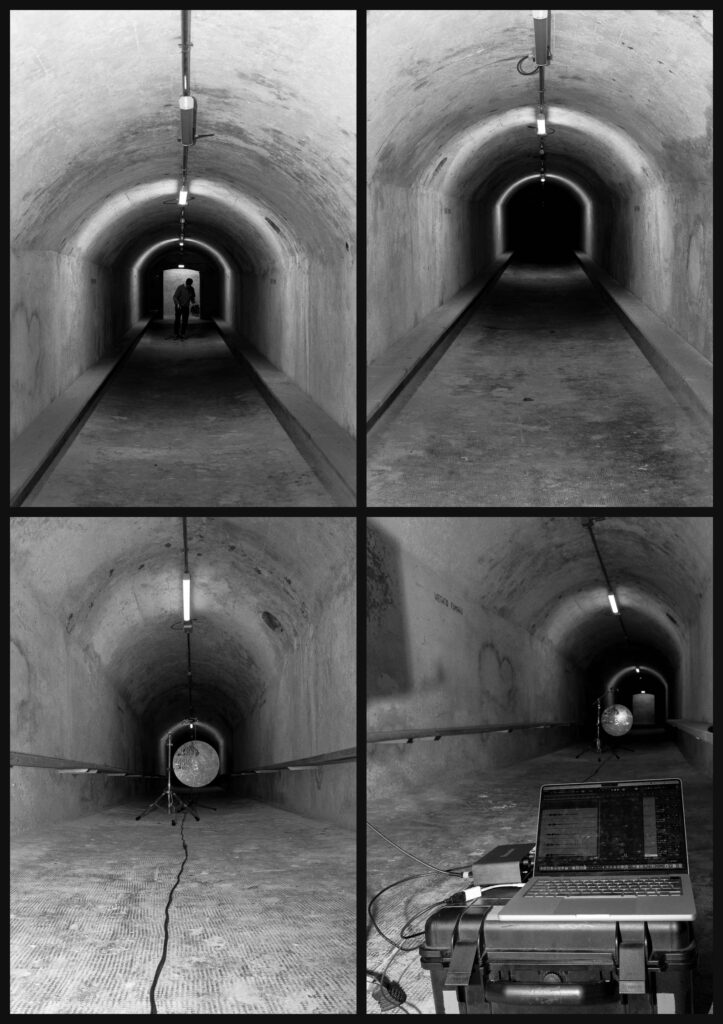
Measuring the tunnel
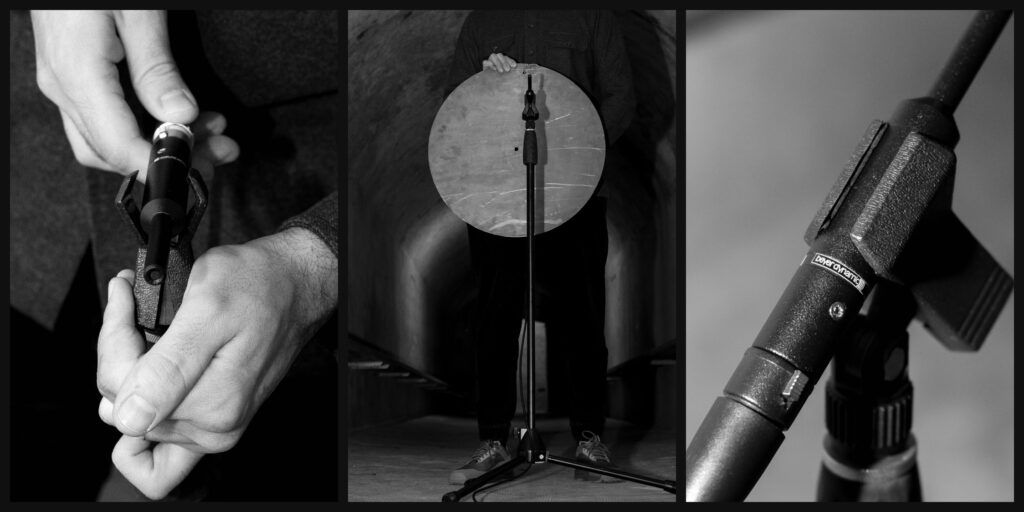
We surveyed it in November 2025 with the exponential sine-sweep method. A single Genelec monitor stood at one end and was turned through six cardinal orientations — up, down, front, back, left, right — and the sweeps averaged, so that a directional loudspeaker would stand in for an omnidirectional source. A Beyerdynamic free-field omni microphone listened from three points along the axis, at roughly eight, ten and twenty-five metres, recording at 48 kHz and 24-bit. Three positions, three impulse responses — the raw description of the tunnel at three distances.
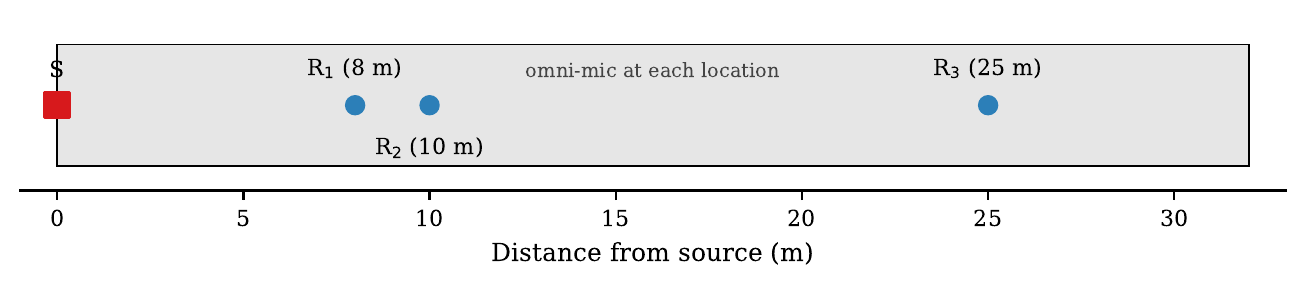
A single source at one end of the tunnel; the omnidirectional receiver placed in turn at three points along the axis.
The space, discretised
Here is the idea the whole project rests on. An impulse response can be written as a sum of damped sinusoids — modes — each with a frequency, a rate of decay, and a weight. Split that description into two, and something useful appears. The frequencies and decay rates — the poles — belong to the room itself: its geometry, its losses, where its resonances sit and how long they ring. The weights are all that depends on where the source and the listener happen to stand. Pin the poles down once, and position stops being a problem in a room and becomes a problem about weights — and weights can be interpolated.
That is the move. Discretise the tunnel into a fixed set of modes, and let the single spatial coordinate live entirely in the residues hung on them. The spatial reverb is, at bottom, modal discretisation with one knob left free.
The catch is that three impulse responses, fitted independently, give three pole sets that are alike but not identical — the same physical mode landing at slightly different frequencies each time. You cannot interpolate two weights unless they hang on the same pole. So we build a common modal basis: the three pole sets are concatenated, clustered along the frequency axis, and each cluster is collapsed into a single representative pole. What comes out is a single, position-invariant bank of about 6,300 modes spanning 70 Hz to 12 kHz. Against that shared basis, the per-position weights — and a short FIR filter that cleans up the early response — are re-fitted jointly, so that all three positions now describe the same modes with different weights, the fit holding to within a few per cent at every point. That shared structure is what makes movement possible.
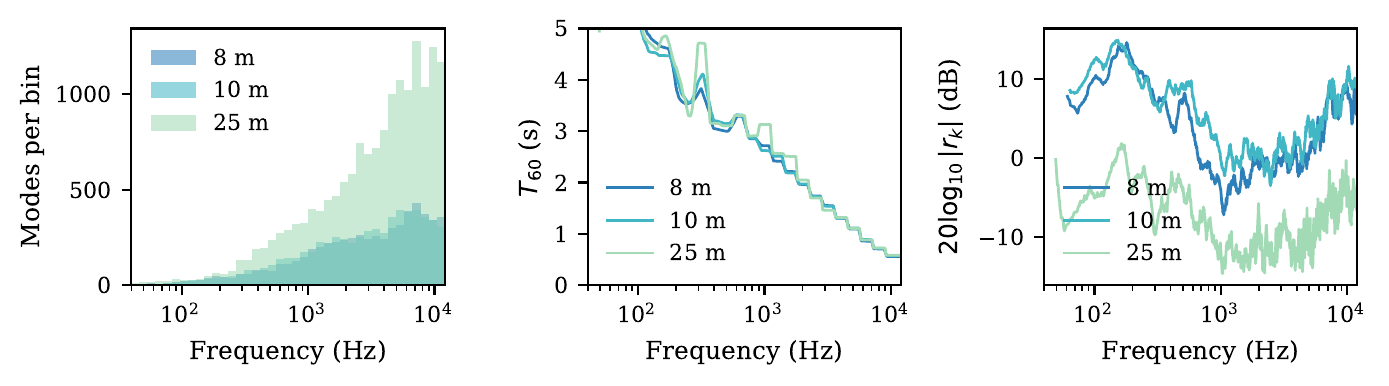
Per-position modal statistics from the three impulse responses: the decay profile is essentially position-invariant, while the mode count and density grow with distance as the far field turns diffuse.
Walking the tunnel
For any point between the measured ones, the weights and filter taps are a plain interpolation of the three sets, with the poles held fixed and a propagation delay added to track the distance from the source. Because the poles never move, the resonator bank is built once and never rebuilt; walking the listener from one end to the other is just arithmetic on a few arrays, and the weights need refreshing only every eighth sample to stay artefact-free. A convolution reverb would have to crossfade between whole impulse responses to do the same thing. Ours runs at around a quarter of one core on an Apple M2, listener in motion.
It is exposed as a single JUCE plugin. Alongside the position control, there is a damping multiplier, a microphone-rotation bias between the source orientations, and Aura, a warping of the high modes that adds brilliance without disturbing the spatial structure. What brings it alive is the modulation: a slow LFO walking the listener up and down the tunnel on a roughly twenty-five-second cycle, the room breathing around a held note while every modal frequency stays exactly where it should. That motion costs nothing — the poles do not care that the listener is moving.
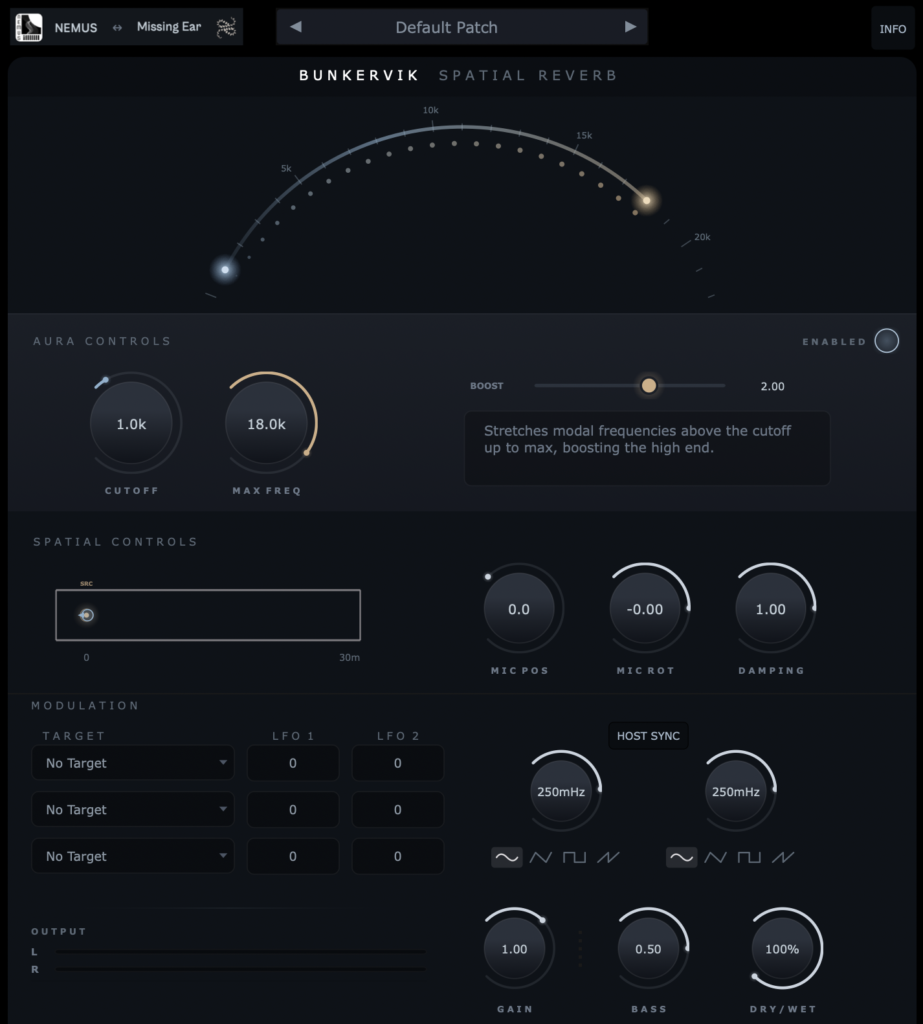
The plugin is free to download from the NEMUS software page, along with the rest of the project’s released tools.
Listen to Matteo’s own preset demos from the Soundcloud playlist.
The plugin’s preset library was developed by Matteo Gualeni. His most recent album, Hotel Infinito (C.O.S.A. Studio Recordings, 2026), draws on the acoustic character of the tunnel as both a material and conceptual reference, the space treated not as a backdrop but as an instrument. His most recent album, Hotel Infinito, draws directly on the Bunkervik as a recording environment: percussion tracks were captured in the tunnel using a Universal Audio Apollo 8 sound card, an AKG 414 microphone, and a microphone preamp. Alongside the impulse-response methodology at the core of this project, these recordings represent a parallel mode of sonic extraction, with the tunnel’s acoustic character embedded in sound through live performance rather than digital convolution.
The plugin itself is a collaboration with Physical Audio, born of a decade of joint research: the modal reverberation approach at its core was engineered for real-time use by Physical Audio, who handled all of the C++ and JUCE development.
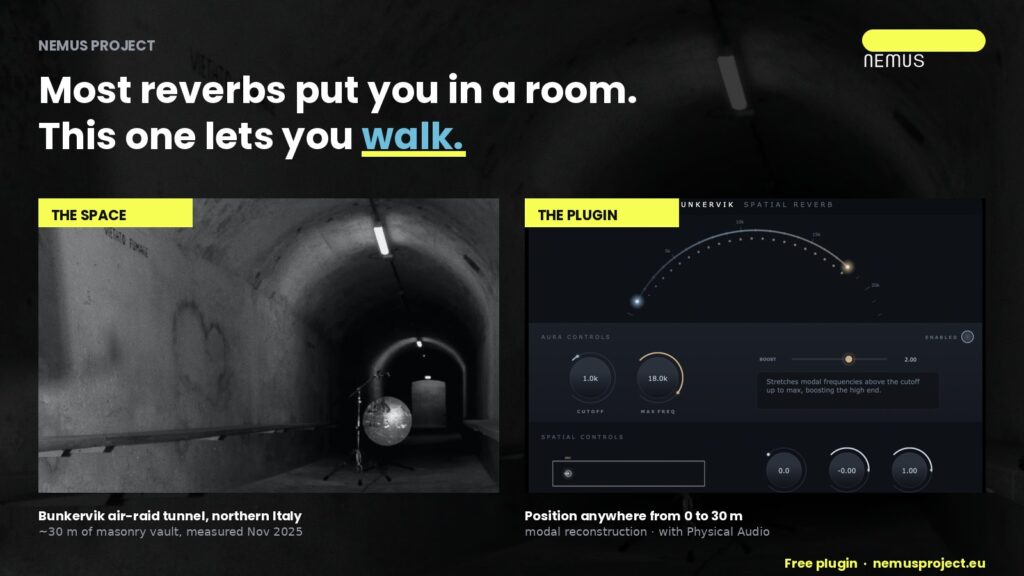
The authors thank the Comune di Brescia and Associazione Culturale Palazzo Monti for access to the Bunkervik venue. The method is described in full in the accompanying technical paper, presented at the International Symposium on Musical Acoustics (ISMA), Helsinki, June 2026.