Impact
Over five years, the project produced mathematical models, free software, concerts, a museum installation and a working copy of a harpsichord built in 1547. People wrote about all of it — in the music technology press, in cultural magazines, in festival programmes and in the academic literature. One of the tools, a synthesiser called MODUS built on the project’s work on nonlinear modal synthesis, won the Innovation Award at the Computer Music Awards in 2023. Here is an account of NEMUS’s impact and outreach among the general public.
From the comment threads — a selection
“Awesome little plugin. Thank you!”
“Straordinario progetto di ricerca!”
“An extraordinary research project!”
“Whoa, I’ve completely missed that. What a gorgeous reverb, thank you!”
“This is really nice, and a freebie at that! Thank you so much.”
“Spettacolo! Pensavo di trovare queste librerie solo su Hauptwerk e invece…”
“Amazing! I thought libraries like this only existed on Hauptwerk…”
“Una storia meravigliosa! Complimenti!”
“A wonderful story! Congratulations!”
“Che lavoro spettacolare, grandi!!”
“What spectacular work — well done!”
“Splendida iniziativa realizzare un controller midi per clavicembalo!”
“A splendid idea, building a MIDI controller for the harpsichord!”
“Bellissimo progetto, congratulazioni a tutti!”
“Beautiful project, congratulations to everyone!”
In the cultural press
- The Edge Magazine — Bionic Renaissance: Voices of the Past Whisper into the Future (15 May 2026, EN) In-depth feature on the Rinascimento Bionico concert by Gadi Sassoon and Maria Luisa Baldassari at Museo San Colombano, Bologna, presenting NEMUS’s digital restoration of the 1547 Alessandro Trasuntino harpsichord and its physical replica built by master luthier Roberto Livi.
- Magnetic Magazine — Gadi Sassoon Releases Forward-Thinking Live Performance Video for Latest Album “Modes of Vibration”
(16 December 2025, EN) On the sculptural synthesiser of metal plates wired with transducers that anchors the album, in a performance supported by NEMUS and showcased at the United Nations AI for Good Summit, alongside the companion TETRAD software synth built with Physical Audio to model the sculpture’s acoustic behaviour. - Il Resto del Carlino — San Colombano, il museo che risuona di antico (2025, IT) On the museum’s renewal, including the augmented keyboard (tastiera aumentata) developed with the University of Bologna’s Department of Engineering, letting visitors play the sounds of historical instruments.
- Il Bo Live – University of Padova magazine — Modelli matematici e computer per far rivivere il suono di antichi strumenti musicali (December 2022, IT) Interview with Michele Ducceschi on building virtual copies of instruments through physics-based mathematical modelling, and on the collaboration with the Tagliavini Collection.
In the music-technology press
Bunkervik Spatial Reverb (free plugin, June 2026)
A free spatial reverb built with Missing Ear (Matteo Gualeni) and Physical Audio, modelling the acoustics of the Bunkervik, a 1940s air-raid shelter beneath Brescia now used as an arts space.
- Bedroom Producers Blog — The NEMUS Project has released Bunkervik SpatialReverb, a FREE spatial reverb plugin (19 June 2026, EN) — highlights the real-time walkthrough of the tunnel via dynamic microphone positioning and the Aura control.
- KVR Audio – news — The NEMUS project releases Bunkervik Reverb (18 June 2026, EN)
- KVR Audio – product database — Bunkervik Reverb by Physical Audio (2026, EN)
- KVR Audio – developer forum — FREE spatial reverb: the Bunkervik tunnel (19 June 2026, EN) — announcement thread and community discussion.
- KVR Audio – video — Bunkervik Tunnel Reverb – Drum Demo (2026, EN)
- Rekkerd.org — FREE: Bunkervik Spatial Reverb effect plugin (June 2026, EN)
- SM Strumenti Musicali — Freeware: Bunkervik Reverb (2026, IT)
- Amner Hunter — 16 Best New FREE Effect Plugins, Vst Instruments, & Audio Plugin Deals — JUNE 2026 Week 3 (June 2026, EN, 41.4K subscribers) — Bunkervik featured in the monthly free-plugin round-up.
- RECnMIX — MixBus Comp Hardware a confronto — The Audio Nerd Show 252 (July 2026, IT, 20.9K subscribers) — Bunkervik discussed from 1:39:17 in the live show.
- Art1fact — This FREE reverb captures a real WW2 Air Raid Tunnel (September 2026, EN, 9.5K subscribers) — Full plugin review.
Trasuntino Kontakt library (free sample library, July 2026)
A free Kontakt instrument sampled from the exact replica of the 1547 Alessandro Trasuntino harpsichord — the oldest known Italian harpsichord with two eight-foot registers, held unplayed in the Tagliavini Collection. The copy was built by Roberto Livi and recorded by Simone Coen (February 2026).
- KVR Audio – news — NEMUS Project Releases Free Kontakt Library Sampled from a Replica of a 1547 Trasuntino Harpsichord (2 July 2026, EN)
- Rekkerd.org — FREE: 1547 Trasuntino harpsichord for Kontakt by NEMUS project (3 July 2026, EN) — with details on the Ottava Corta and Esteso patches and meantone tuning at A4 = 415 Hz.
- SM Strumenti Musicali — Nemus Project Trasuntino: il clavicembalo Free! (July 2026, IT)
- Cakewalk / BandLab community forum — release thread (July 2026, EN)
- A Joe-Blog Composer — FREE Rebuilt Upright, Harpsichord, Dark Ambient and Trailer SFX | FREE Sample of the Week (July 2026, EN, 10.1K subscribers) — walkthrough of the Trasuntino library, opening the episode.
MODUS (Physical Audio, July 2023) — built on NEMUS research
MODUS, Physical Audio’s physical-modelling synthesizer of interconnected strings, plates, springs and rattles, is built on the nonlinear modal synthesis methods published by the NEMUS team in 2023. It won the Innovation Award at the Computer Music Awards 2023.
- Computer Music magazine — Innovation Award 2023 — The Awards Issue 2023 (February 2024 issue, EN) — MODUS named winner of the Innovation Award in the magazine’s annual round-up of the year’s best music-production releases.
- Computer Music magazine — review — Physical Audio Modus by Andy Jones, December 2023 issue (EN) — the print review behind the MusicRadar text.
- MusicRadar – news — Physical Audio’s Modus synth plugin promises to “push the boundaries” of real-time physical modelling synthesis (July 2023, EN)
- MusicRadar – review — Physical Audio Modus review (November 2023, EN) — verdict: “Modus demonstrates what physical modelling technology should be used for, that is doing something unusual and new. It does it very well indeed.”
- Synth Anatomy — Physical Audio Modus, new physical modeling synth plugin explores strings and plates (2023, updated January 2024 for v1.3, EN)
- KVR Audio – news — Physical Audio releases Modus (VST/AU/AAX) – Physical Modelling Synth (11 July 2023, EN), plus product page and user reviews and a long-running community thread
- Gearspace — release thread and discussion (July 2023, EN)
- Rekkerd.org — Modus giveaway contest (3 licences) and Physical Audio synth sale coverage (EN)
- Databroth — MODUS review + video (July 2023, EN, sponsored)
- Dash Glitch — This NEW PLUGIN is WEIRD! Modus by Physical Audio (2023, EN, 75.8K subscribers, 13K views) — 20-minute hands-on walkthrough.
- YouTube — further independent reviews, e.g. MODUS Synth Plugin Review (2023, EN)
Tetrad (Physical Audio, June 2025) — developed with Gadi Sassoon and the NEMUS team
Tetrad, a hybrid physical-modelling/granular synth built around four modelled slashed plates, is the digital twin of Gadi Sassoon’s sculpture-based synth installation heard on Modes of Vibration, and grew out of experiments with the NEMUS team.
- Sound On Sound — Physical Audio introduce Tetrad (June 2025, EN)
- Synthtopia — New Synth, Tetrad, Combines Physical Modeling & Granular Synthesis (21 June 2025, EN) — with a reader verdict calling it “easily one of the best synth releases of 2025 so far.”
- Attack Magazine — Tetrad Synth Plugin Marries Physical Modelling and Experimental Art (July 2025, EN)
- MusicTech — Granular synth plugin Tetrad is “like no other”, apparently (2025, EN) — quotes Sassoon on the project starting “as an experiment… with the team of Nemus Project.”
- Sonic State — Physical Audio Launches Tetrad synthesizer (20 June 2025, EN)
- Synth Anatomy — Physical Audio Tetrad Synthesizer plugin combines slashed metal plates with hybrid synthesis (19 June 2025, EN)
- KVR Audio – news — Physical Audio releases Tetrad Synthesizer Plugin (VST3/AU/AAX) (19 June 2025, EN)
- The Beat Community — Physical Audio Release Tetrad (19 June 2025, EN)
- Audio Plugin Guy — Physical Audio Launches Tetrad Virtual Synth Plugin (24 June 2025, EN)
Concerts, events and museum programming
- Eufonica 2026 (BolognaFiere) — From Restoration to Digital Simulation: Sound Between Memory and Innovation (7 May 2026, EN/IT) Official announcement of the Bionic Renaissance concert (two performances) with technologies developed within NEMUS, alongside the “Soul of Sound” guided tour of the Tagliavini Collection.
- MEI – Meeting delle Etichette Indipendenti — Eufonica 2026 full programme (2026, IT) — lists Rinascimento Bionico with Gadi Sassoon and Maria Luisa Baldassari, “con le tecnologie sperimentali del progetto ERC NEMUS”.
- Confcommercio Ascom Bologna – Confguide newsletter — 7 May 2026 edition (IT) — the 13 May concert at Museo San Colombano, the 14 May guided tour with cembalaro Graziano Bandini, and the 15 May performance at the Fiera.
- Fondazione Carisbo — San Colombano: il museo della musica che suona (2025, IT) — the museum’s new season, featuring the augmented keyboard developed with the University of Bologna.
- City listings: Cultura Bologna · Città della Musica – Bologna UNESCO City of Music · Bologna Welcome
Institutional and European Union coverage
- European Commission – CORDIS — Project 950084 fact sheet (multi-language) Official EU record of the project: ERC Starting Grant, €1,497,265 EU contribution, 1 July 2021 – 30 June 2026, with periodic reporting.
- University of Bologna – RicERCatori in evidenza — The sound of ancient instruments comes back to life through research (2022, EN — versione italiana) Feature on the project’s goals and early results, including a reported 350× speed-up in real-time string simulation.
- University of Bologna – Horizon 2020 project page — NEMUS (EN)
- Department of Industrial Engineering (DIN) — European and International Projects (EN)
Academic footprint
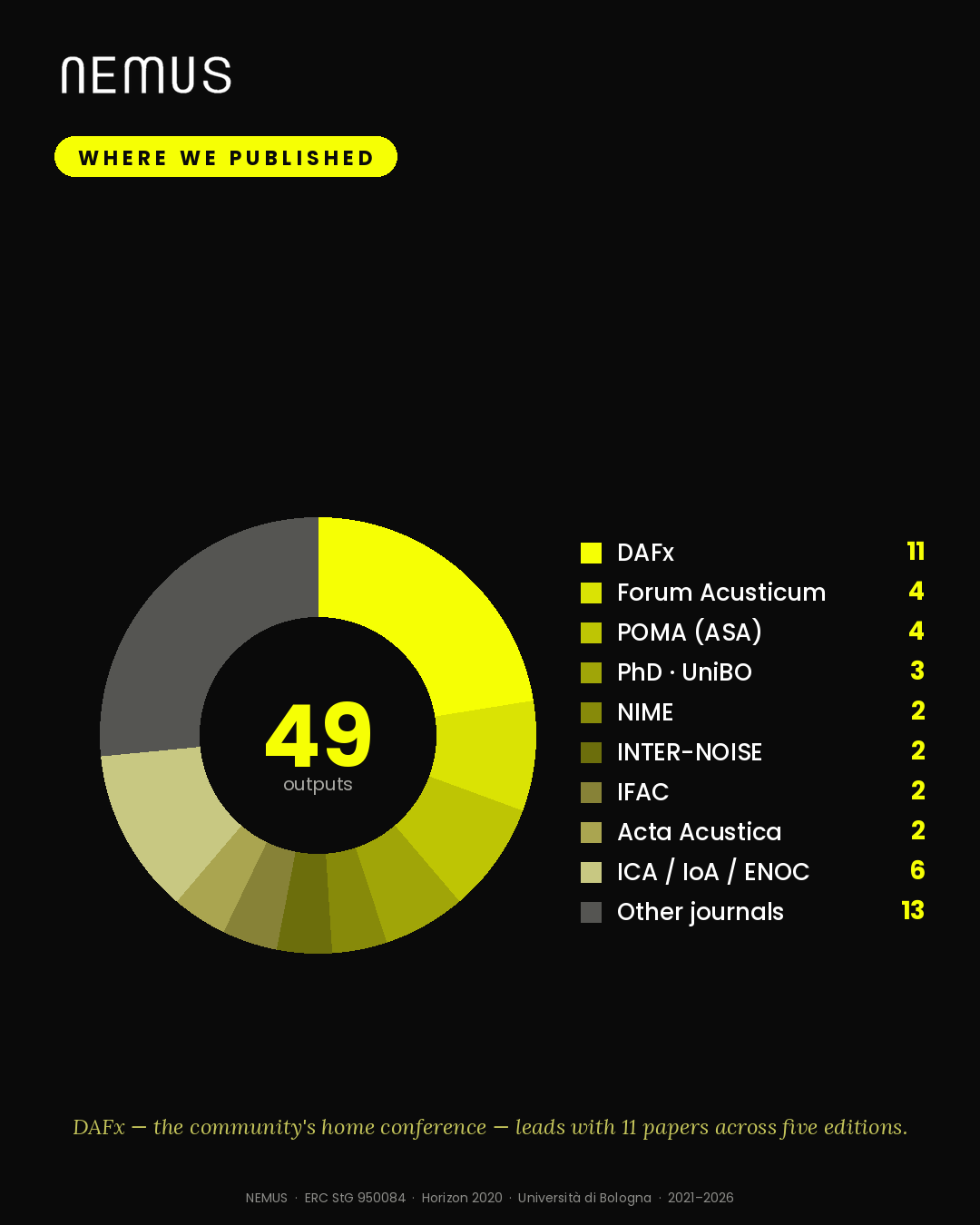
The full list of publications is available on the Publications page.
Ripple effects: artists and industry
- Gadi Sassoon — the composer’s Modes of Vibration (2025) and related tools were developed with support from NEMUS and Physical Audio, as noted on his official site and his MUTEK Montréal artist profile.
- Matteo Gualeni (Missing Ear) — his album Hotel Infinito (C.O.S.A. Studio Recordings, 2026) treats the Bunkervik tunnel as an instrument, in parallel with the NEMUS acoustic modelling that produced the free reverb plugin.
- Physical Audio — the UK developer’s research pages document the ongoing collaboration, from the NESS project at Edinburgh through to the NEMUS-era plugins and roundtables.
- YouTube roundtable — Physical Modelling, Historical Keyboards and Granular Synths: Exploring the NEMUS project — a filmed conversation between Michele Ducceschi, Stefan Bilbao, Craig Webb and Gadi Sassoon on a decade of physical-modelling research.
Five years of NEMUS — the record, in numbers
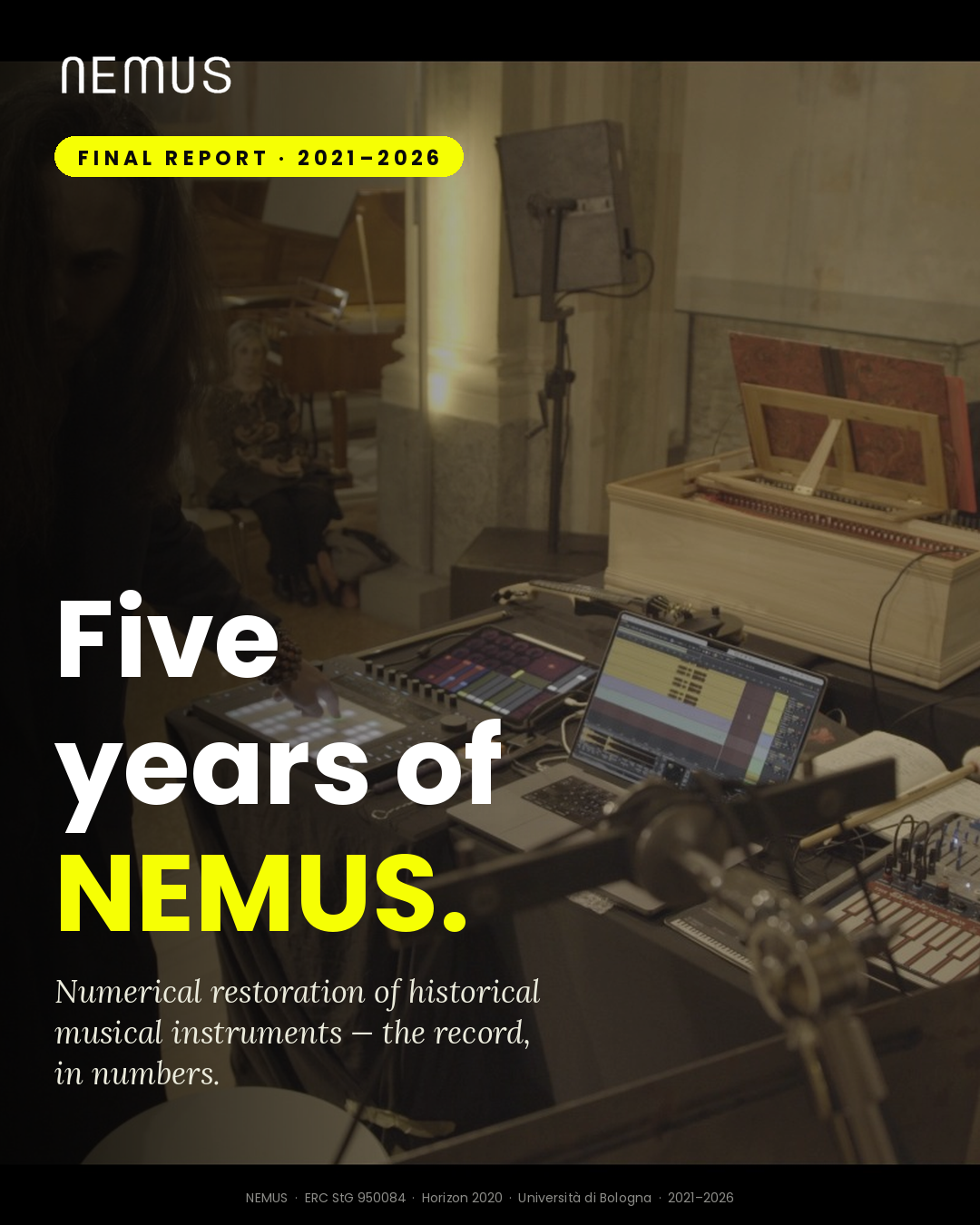
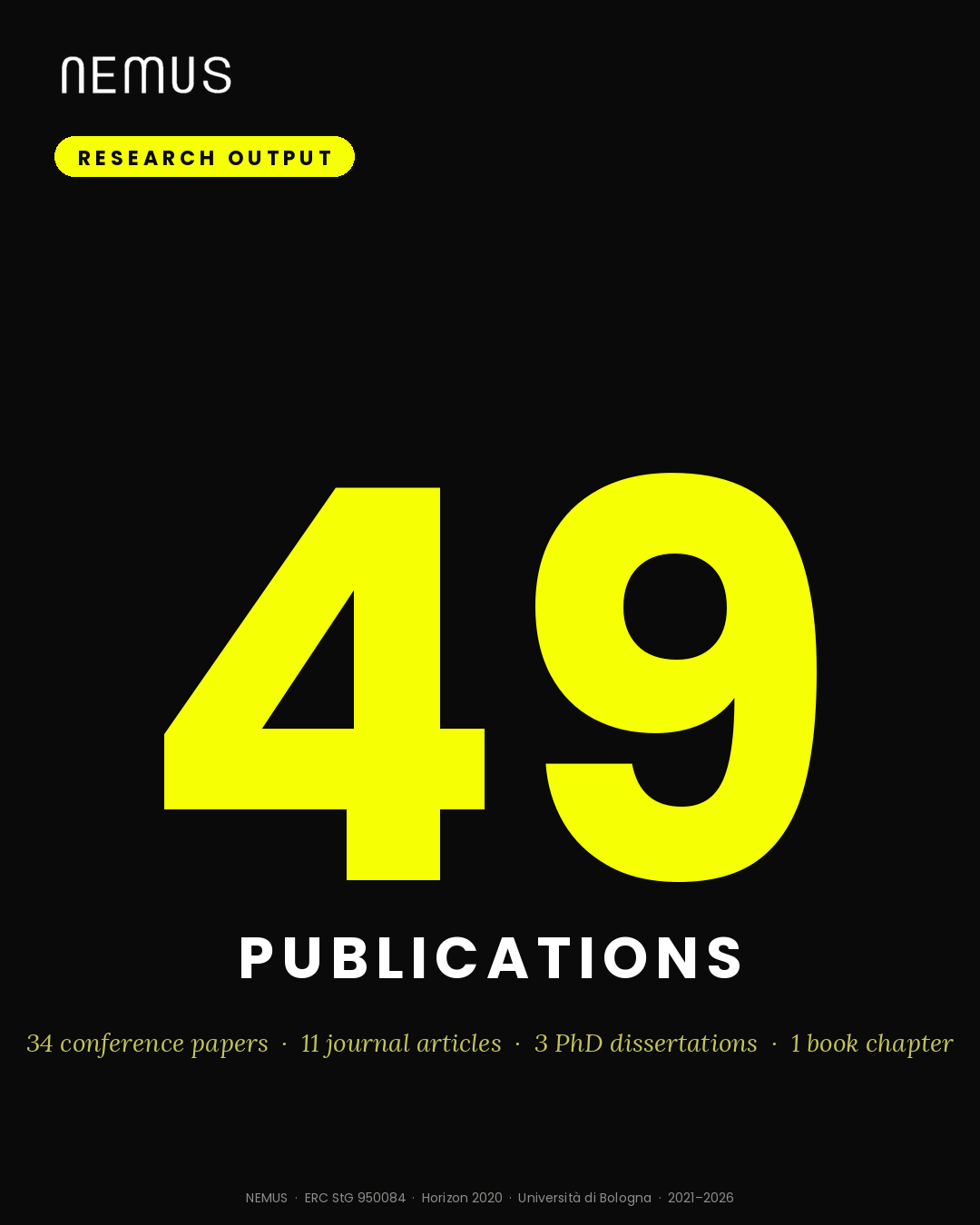
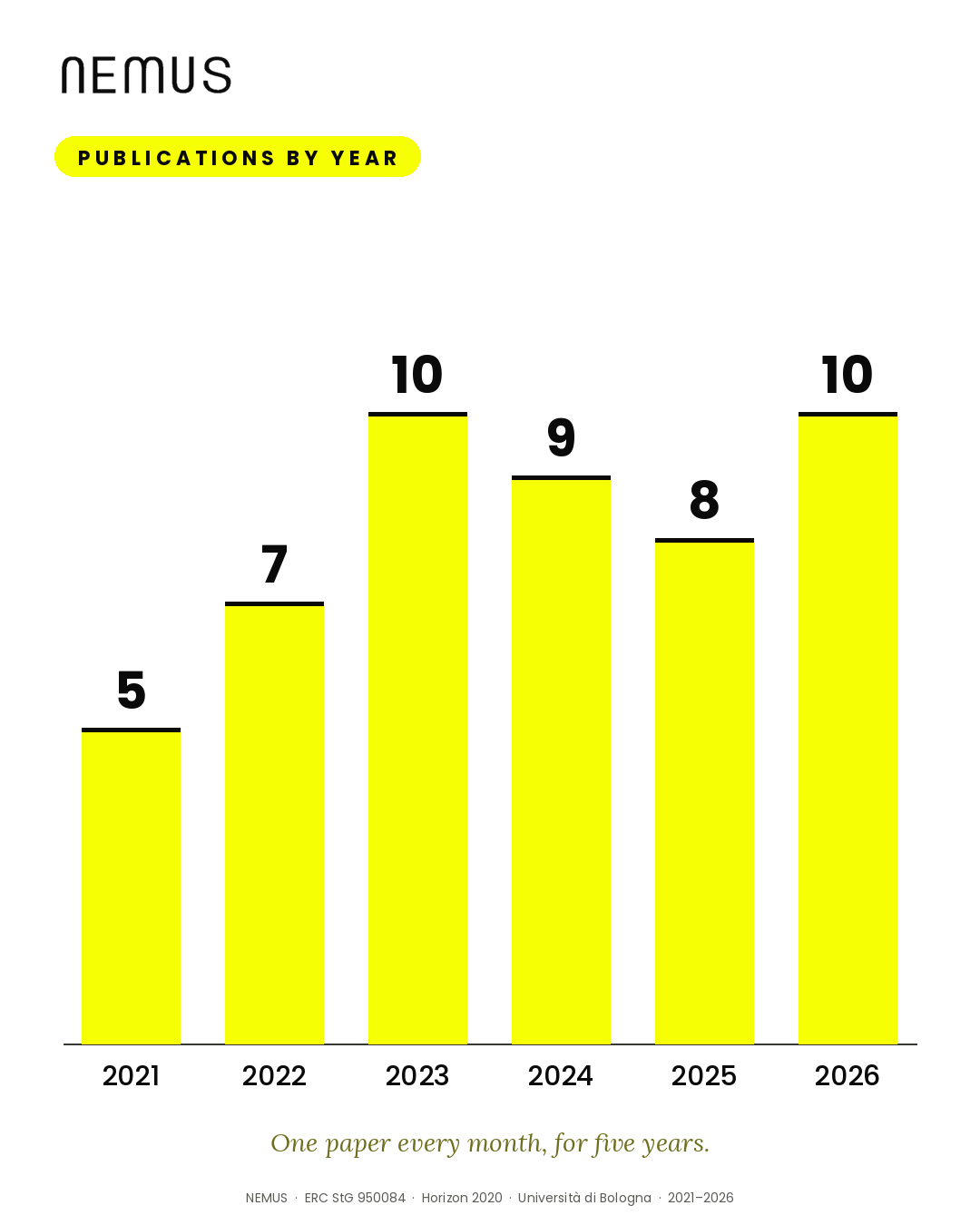
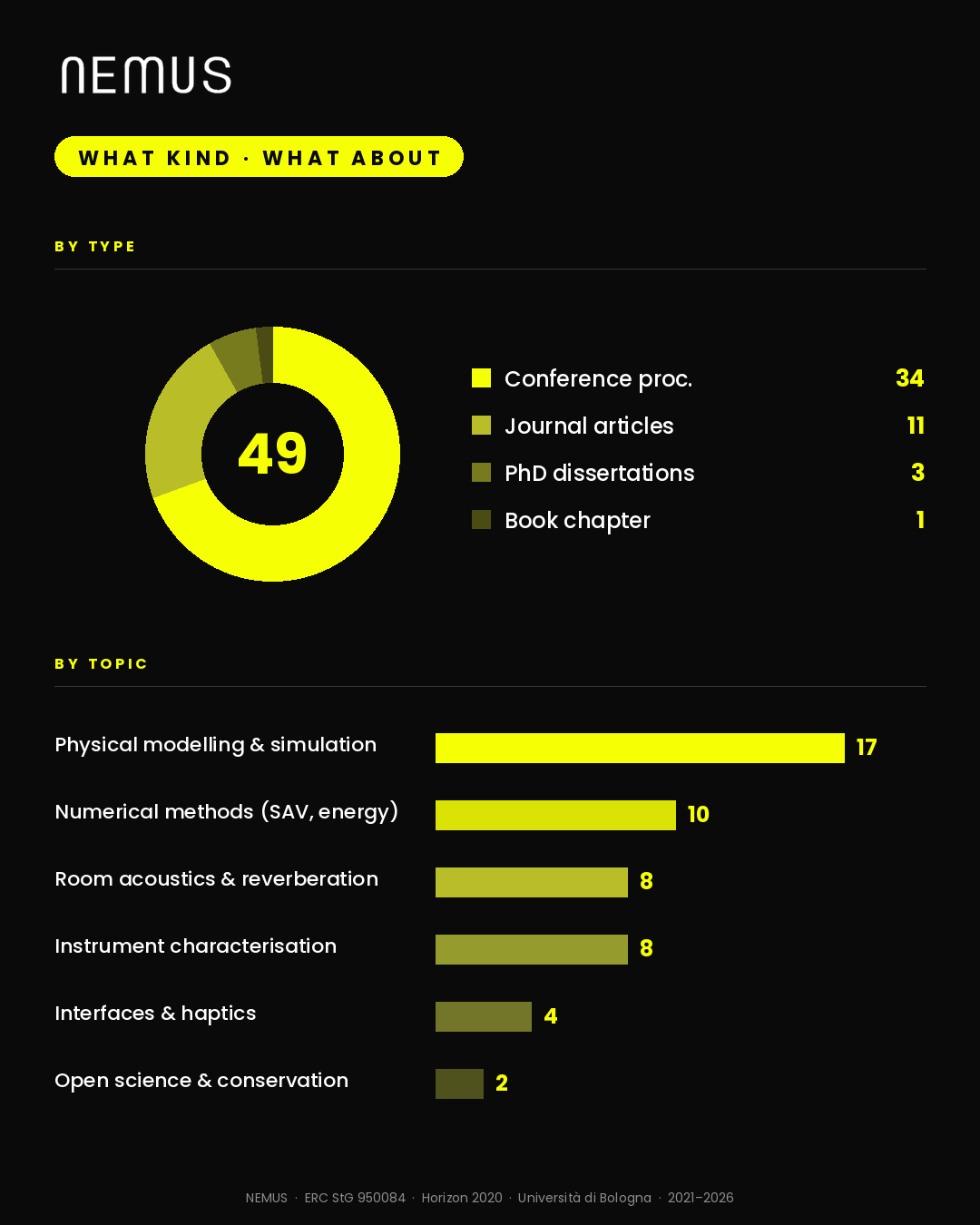
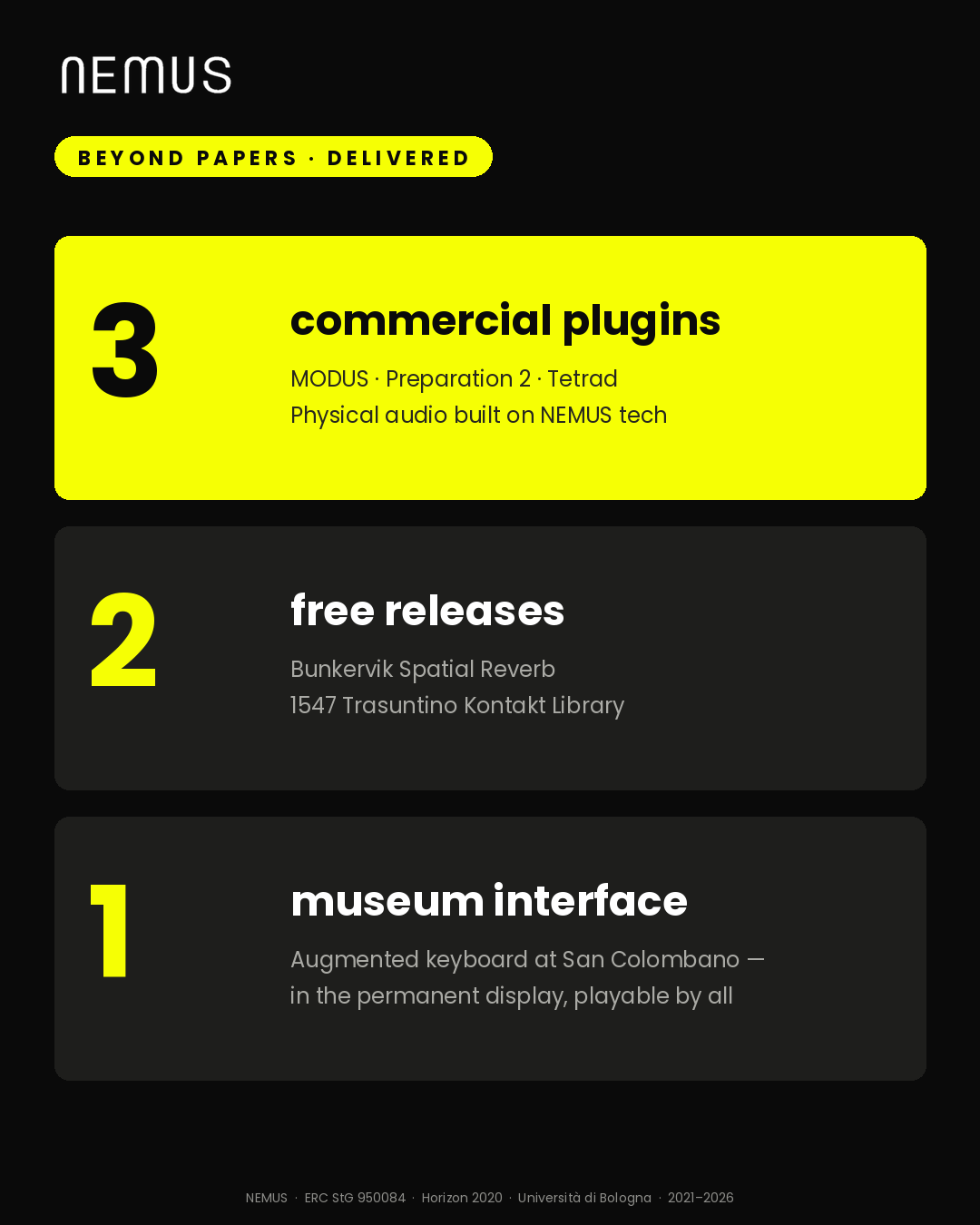
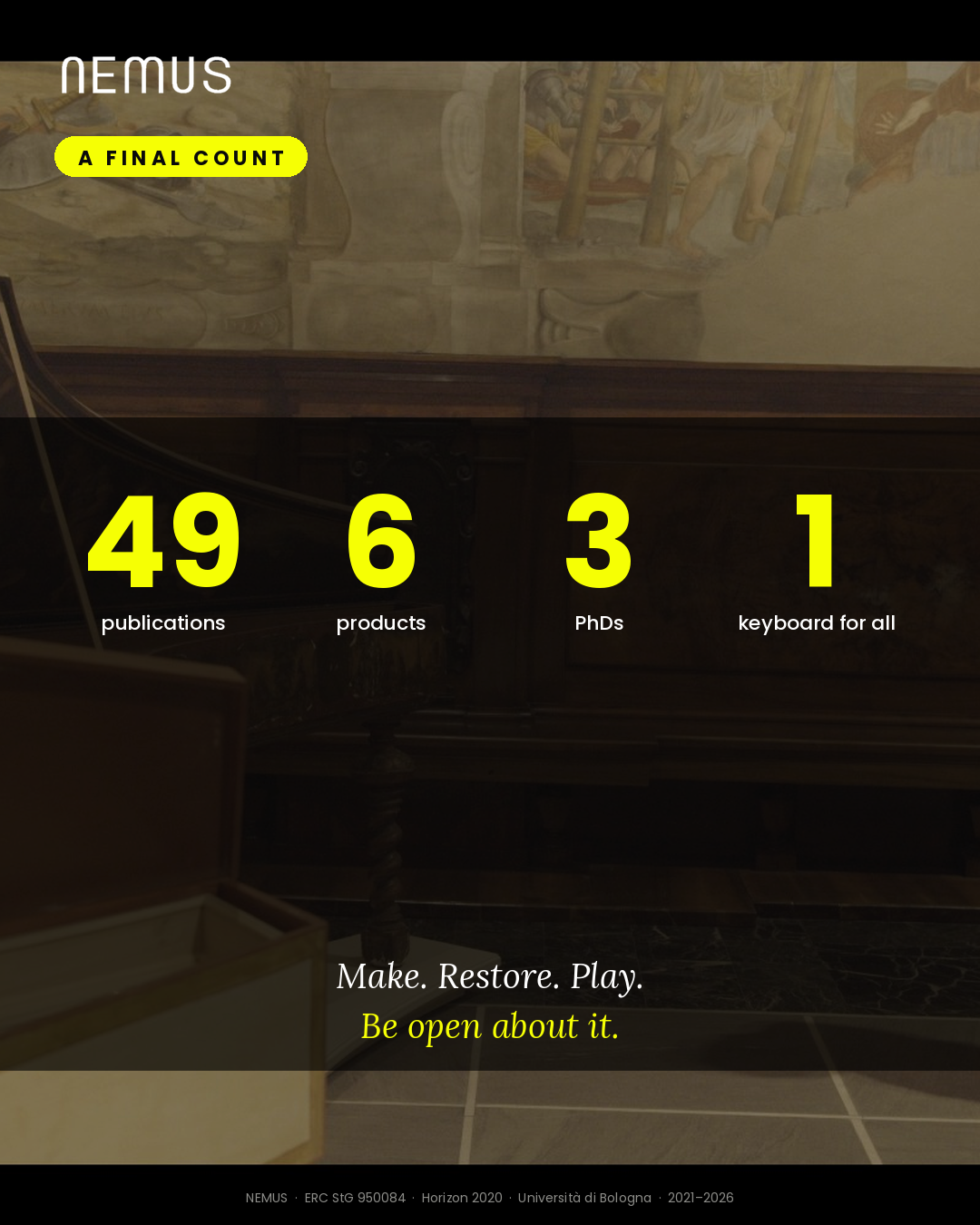
The final report of the project, condensed into a visual deck: 49 publications (34 conference papers, 11 journal articles, 3 PhD dissertations, 1 book chapter — one paper every month, for five years), 5 software releases (3 commercial plugins built on NEMUS technology — MODUS, winner of the Computer Music Innovation Award 2023, Preparation 2 and Tetrad — and 2 free releases, Bunkervik Spatial Reverb and the 1547 Trasuntino Kontakt library), 3 PhDs, and 1 augmented keyboard in the permanent display at Museo San Colombano — playable by all. Six products in total.
This page is updated periodically. If you have written about NEMUS and don’t see your piece here, get in touch.