How Small Electro-Dynamic Transducers Change Musical Acoustics Measurements

By Ludovico Ausiello, Michele Ducceschi, Sebastian Duran, and Benjamin Morrison
A guitar soundboard can reveal an enormous amount about its acoustic behaviour. Traditionally, that has required impact hammers, expensive instrumentation, and carefully controlled laboratory conditions. Within NEMUS, a different approach was validated: using small electro-dynamic transducers driven by wide-band signals to transform musical acoustics measurements into a repeatable, affordable, and workshop-friendly process.
The idea is deceptively simple. Instead of striking a soundboard once with an impact hammer and recording the resulting vibration, a miniature electro-dynamic actuator continuously excites the structure using signals such as sine sweeps or pink noise. Combined with inexpensive audio hardware and straightforward signal processing, this creates a flexible measurement ecosystem capable of capturing detailed vibroacoustic responses over a bandwidth reaching several kilohertz.
The approach was validated experimentally on spruce soundboards and then applied to two practical case studies: tuning raw soundboards toward a target response, and monitoring the acoustic effect of moving braces in real time.
Why Traditional Impact Measurements Are Limiting
Experimental modal analysis in musical acoustics is often performed using an impact hammer. The method is conceptually straightforward: the structure is struck with a calibrated hammer, and its response is measured using an accelerometer, vibrometer, or microphone.
The technique works well, but it also presents limitations.
Because the excitation is impulsive, the available energy decreases rapidly toward higher frequencies. Measurements can depend strongly on the hammer tip material, the repeatability of the impacts, and the exact striking location. In workshop environments — where instrument makers may wish to monitor changes continuously during construction — the setup can become cumbersome.
Wide-band excitation methods based on sine sweeps offer a different possibility. Instead of a single impulse, the structure is driven continuously across a controlled frequency range, producing responses with high coherence over a much broader bandwidth.
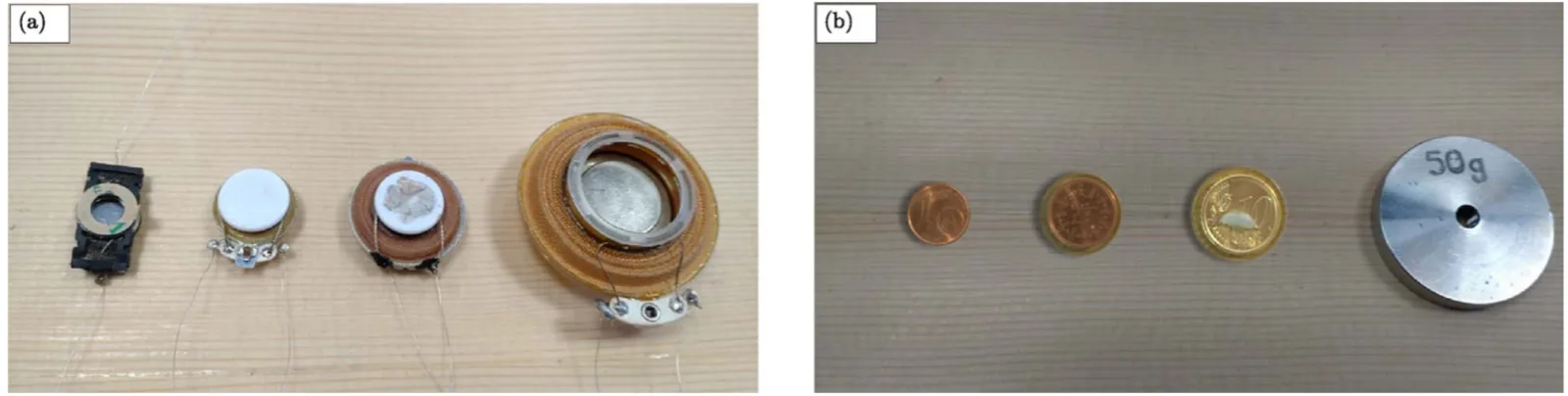
Fig. 1. The four electro-dynamic transducers used in the study, ranging from lightweight miniature actuators to larger and more powerful devices. Their masses span approximately 2.5 g to 50 g, allowing investigation of how actuator size affects the measured response of the soundboard.
The experimental setup explored in this work relies on compact electro-dynamic transducers attached directly to the soundboard surface using wax or putty. Four actuators of different sizes and moving masses were tested, together with low-cost audio interfaces, microphones, and accelerometers.
The resulting system is inexpensive compared with traditional laboratory modal analysis equipment, yet capable of producing reliable acoustic measurements across a wide frequency range.
A Wide-Band Measurement Ecosystem
The experimental signal chain was intentionally designed around accessible hardware.
A laptop generated either exponential sine sweeps or pink noise, which were amplified and sent to the transducers attached to the wooden plates. The structural response was then captured either through an accelerometer or a near-field microphone.
To validate the method, the researchers compared measurements obtained using the small transducers against benchmark measurements gathered with a professional impact hammer.
The first experiments were performed on an unbraced spruce board clamped inside a rigid plexiglass frame.
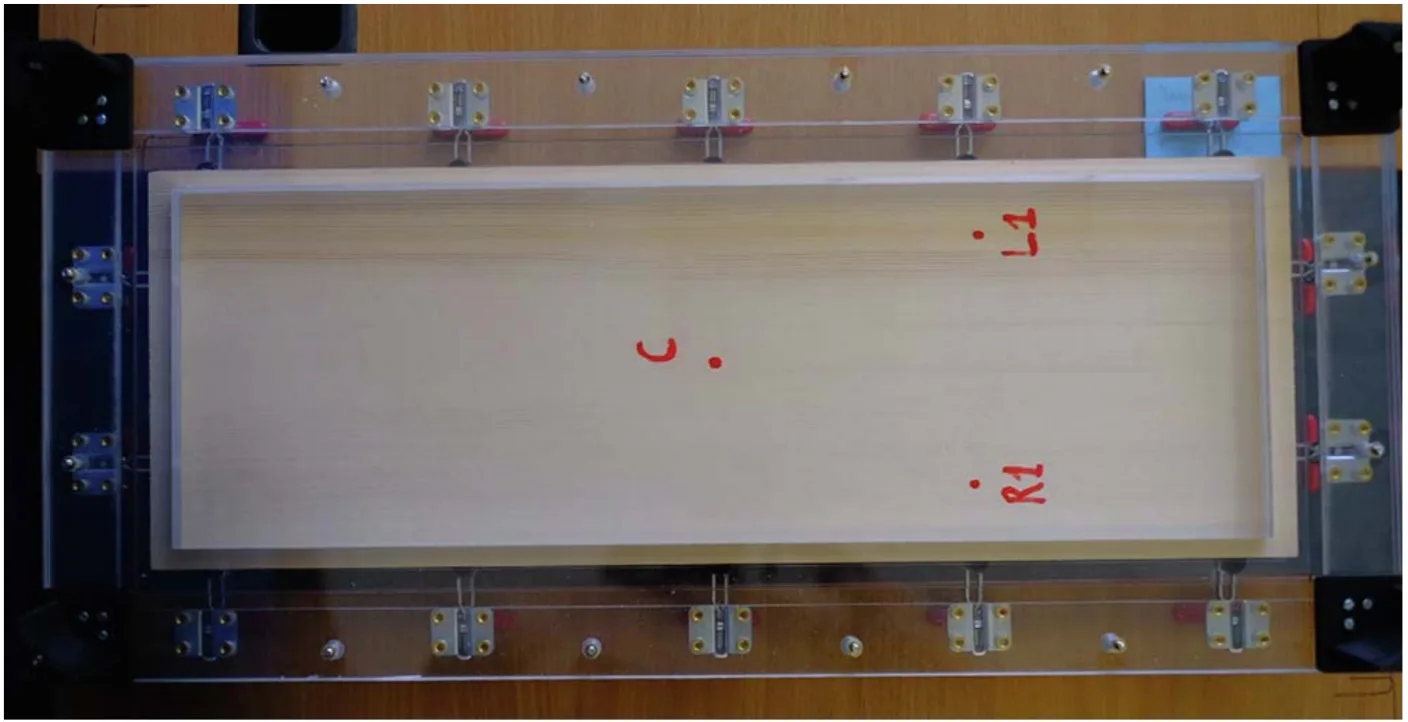
Fig. 2. Experimental setup used to validate the electro-dynamic transducers against traditional impact hammer measurements. The spruce plate is clamped inside a rigid plexiglass frame; the labelled excitation points were chosen to investigate how actuator placement affects the measured response.
The comparison revealed that three of the four tested transducers reproduced the benchmark measurements remarkably well. In particular, the sine sweep approach maintained strong coherence up to approximately 8 kHz — substantially beyond the range where the impact hammer measurements began to degrade.
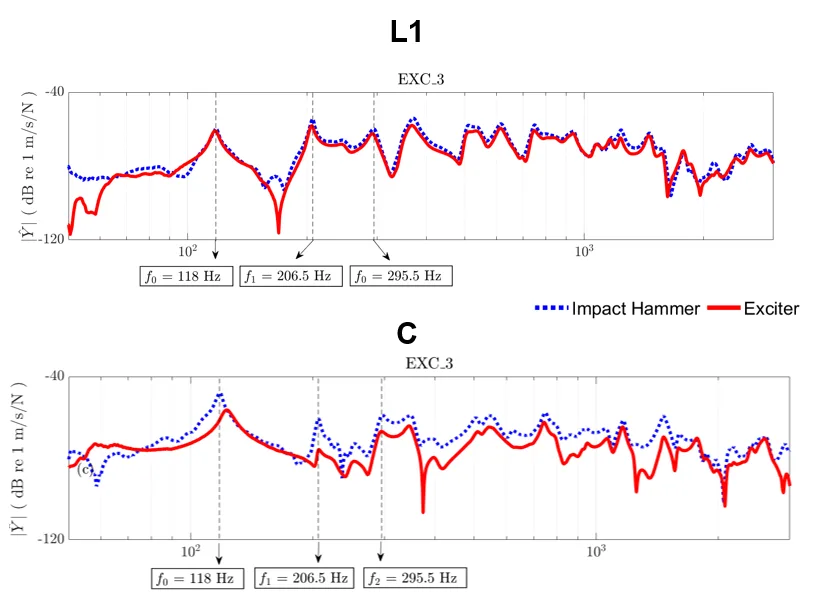
Fig. 3. Comparison between benchmark impact hammer measurements and responses obtained using electro-dynamic transducers driven by sine sweeps. Three of the four actuators reproduced the modal behaviour of the board closely across a wide frequency range.
One important observation emerged immediately: the transducer itself can influence the vibrational response of the structure.
A passive added mass simply shifts resonance frequencies downward. A coupled electro-dynamic actuator behaves differently. Depending on where it is attached, the device can stiffen the structure dynamically and alter the measured modal behaviour.
Understanding this interaction became one of the central insights of the work.
When the Transducer Becomes Part of the System
The measurements showed that excitation position matters enormously.
When the actuator was attached near a modal antinode — where the plate undergoes large motion — the transducer interacted strongly with the vibration mode itself. In some cases, the first resonance frequency shifted upward rather than downward, revealing that the actuator was behaving not as a passive mass but as an active coupled mechanical system.
This effect became particularly clear through electrical impedance measurements.
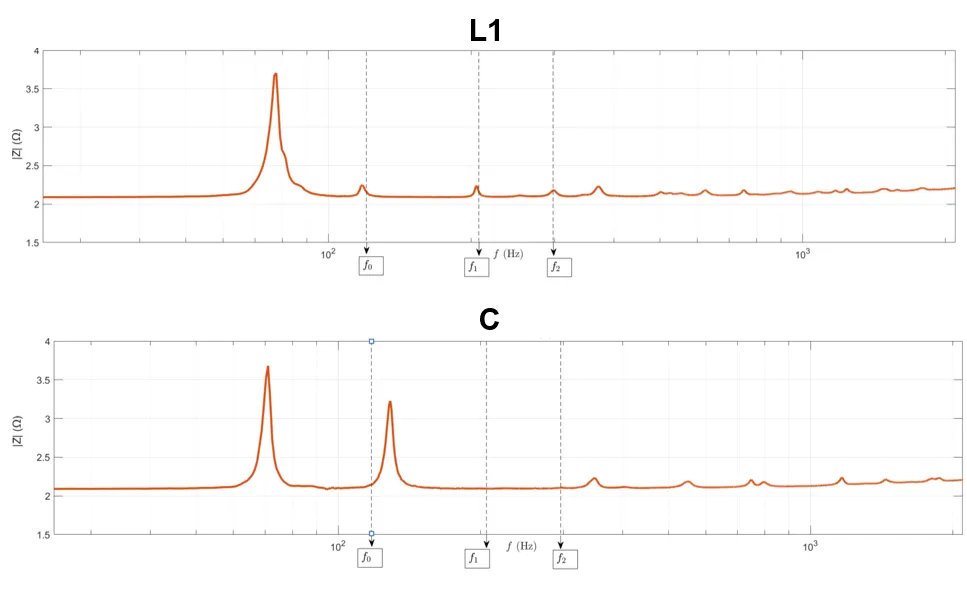
Fig. 4. Electrical impedance measurements of the transducers attached at different excitation points. A good excitation point produces a clean impedance response with minimal interaction between the transducer and the structural modes of the board.
In loudspeaker engineering, electrical impedance curves reveal how the moving mass, compliance, and damping of a driver interact mechanically. Here, the same principle was used to study the coupling between the transducer and the wooden plate.
Certain attachment points produced a single dominant impedance peak, indicating relatively neutral coupling between the actuator and the board. Other positions generated split peaks and more complex behaviour, signalling strong interaction with compliant vibration modes.
This provided a practical way to identify reliable excitation points before performing acoustic measurements.
A useful interpretation emerged from loudspeaker theory itself.
When attached in a suitable location, the transducer-board system behaves similarly to a loudspeaker operating in free air. When attached at a strongly compliant point, the coupled system instead resembles a loudspeaker mounted inside a vented enclosure, where additional resonances emerge from the interaction between the driver and the acoustic cavity.
The analogy offers an intuitive physical picture for understanding when a transducer is behaving transparently — and when it is significantly altering the response it is supposed to measure.
Continuous Measurements Instead of Single Impacts
One of the major advantages of electro-dynamic transducers is that they allow continuous excitation.
Rather than striking the structure repeatedly and averaging multiple impacts, the soundboard can be driven continuously while its response is monitored in real time.
This capability opens the possibility of workshop-scale acoustic measurements during instrument construction.
To demonstrate this, the researchers tested a collection of raw quarter-sawn spruce soundboards supplied for guitar construction.
Each plate was mounted in the same clamping frame and excited using wide-band sine sweeps. The resulting spectra showed substantial variability between nominally similar pieces of wood.
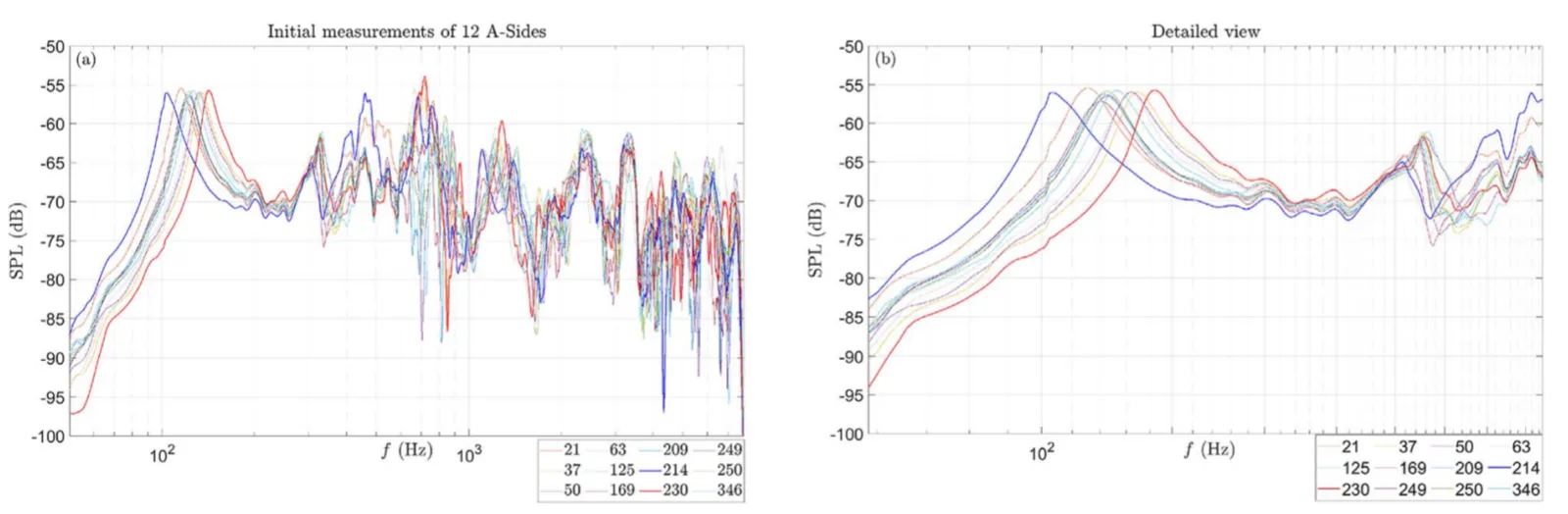
Fig. 5. Initial measurements of twelve spruce soundboards. Despite similar densities and nominal grading, the boards show significant variation in their low-frequency modal responses.
Groups of boards were then progressively thinned using a drum sander and re-measured after each machining step.
The goal was intentionally simple: align the first resonance frequency of several plates toward a shared acoustic target.
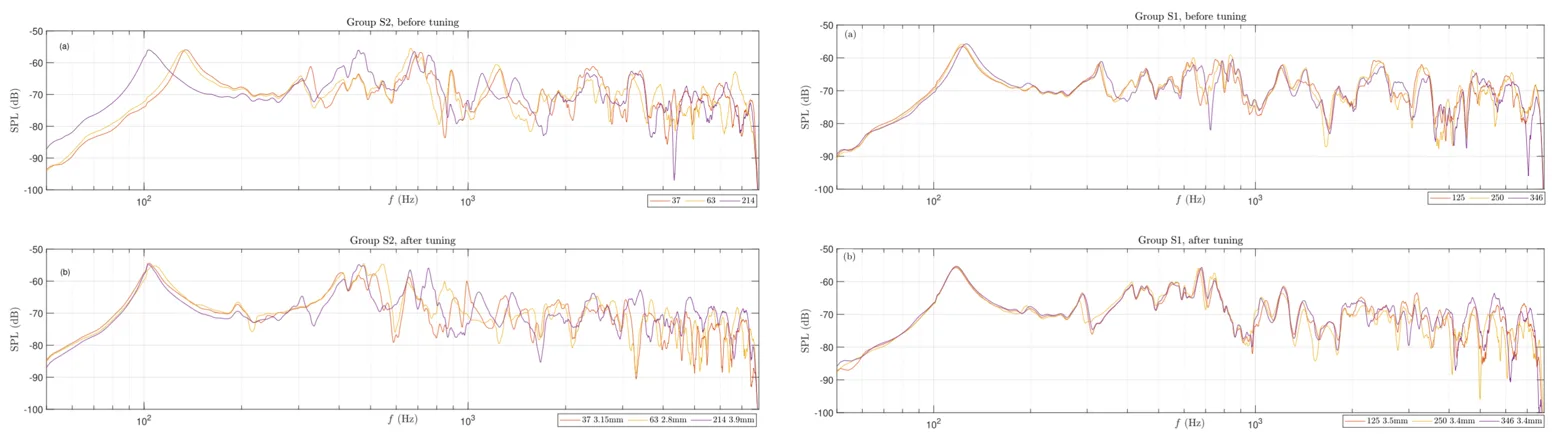
Fig. 6. Soundboards before and after tuning toward a common target resonance. The measurements demonstrate how wide-band transducer excitation can support practical workshop-scale acoustic adjustment procedures.
After tuning, the spectra of the selected boards showed strong agreement not only in the fundamental mode but across a broad frequency range extending toward 1 kHz.
The experiment demonstrated that low-cost transducer-based measurements can provide immediate feedback during material selection and structural adjustment.
Watching Braces Change the Spectrum in Real Time
The most visually striking part of the work involved real-time spectral analysis.
A small spruce plate mounted as a cantilever was fitted with movable braces held in place magnetically. Two brace configurations were investigated: a lightweight wooden brace and a heavier metallic brace.
The plate was continuously excited using pink noise generated through a small electro-dynamic transducer while a real-time spectrum analyser monitored the vibrational response.
As the braces were moved across the plate surface, the spectrum changed immediately.
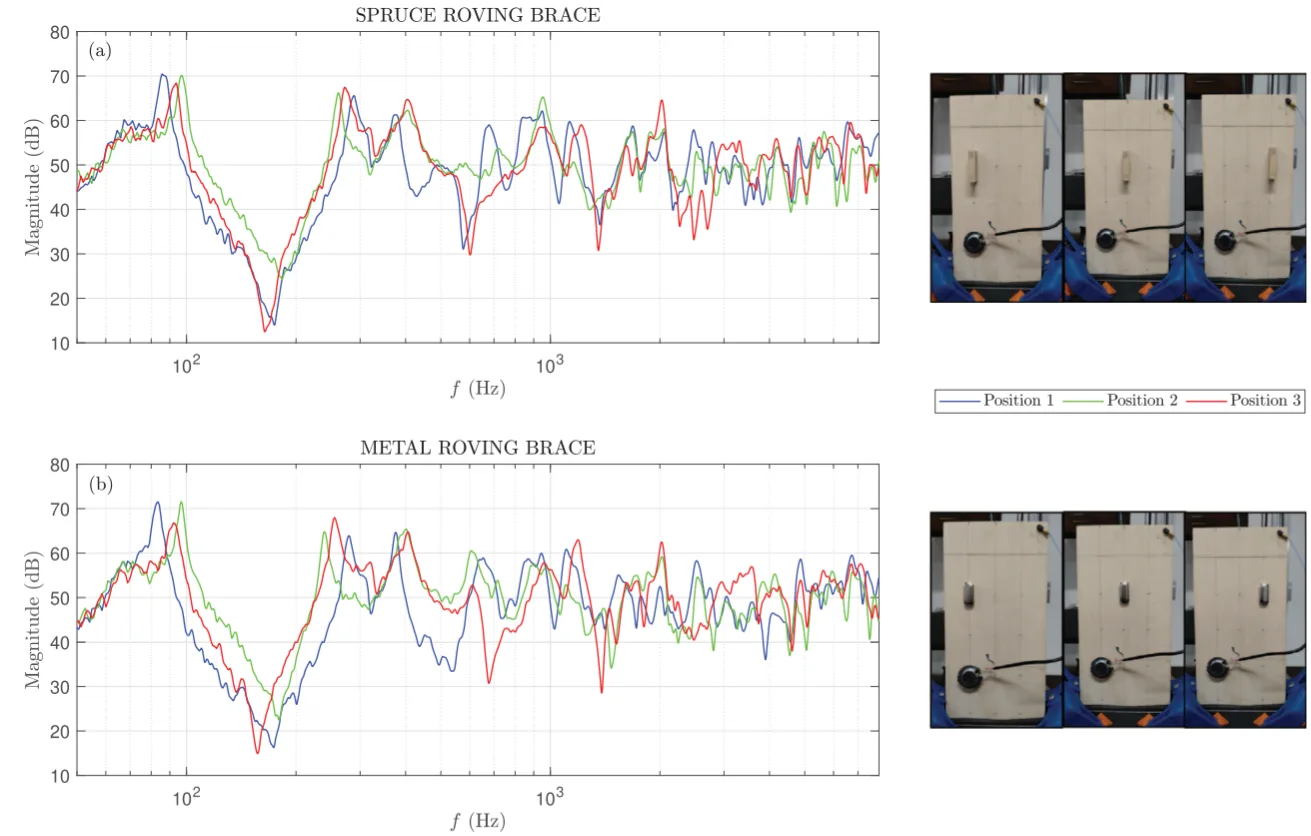
Fig. 7. Real-time spectral analysis of a cantilever spruce plate using movable braces. The plate is continuously excited using a small electro-dynamic transducer while spectral changes are monitored live.
The experiments revealed how strongly local structural modifications affect modal behaviour.
Even relatively small changes in brace position altered the amplitudes and frequencies of multiple resonances simultaneously. Because the excitation was continuous, these effects became visible instantly rather than requiring repeated impact measurements.
The accompanying supplementary videos show the real-time analysis process for both the wooden and metallic brace configurations.