What Offcuts Can Tell Us About a Soundboard

By Sebastian Duran, Henna Tahvanainen, Ludovico Ausiello, and Michele Ducceschi
When building or restoring a stringed instrument, access to the original soundboard for measurement is not always guaranteed. The instrument may be in use, held in a museum, or simply no longer available. Yet accurate material characterisation of the soundboard is often a prerequisite for building a reliable physical model, or for reproducing a known acoustic target in a copy.
A paper presented at the 188th Meeting of the Acoustical Society of America (ASA/ICA 2025, New Orleans) investigates a practical alternative: using tonewood leftovers — the small offcuts produced when a soundboard blank is shaped to its final outline — to estimate the elastic constants of the full board.
The Core Question
The idea is straightforward in principle. When a luthier cuts a guitar or kantele top plate to shape, rectangular scraps are left over. These scraps come from the same piece of wood as the soundboard itself, and could in theory carry the same elastic properties. If reliable elastic constants can be extracted from a leftover, a finite element model of the full plate could be built and validated without ever handling the instrument directly.
The study examines two instruments — a guitar and a concert kantele — and asks whether this approach is feasible, consistent across different measurement setups, and sufficiently accurate for practical use.
Case Study 1: Guitar Top Plate
A spruce guitar top plate was shaped from a book-matched blank, and a small rectangular leftover (approximately 77 × 93 mm, 3.3 mm thick) was recovered from the off-cut material at the upper bout.
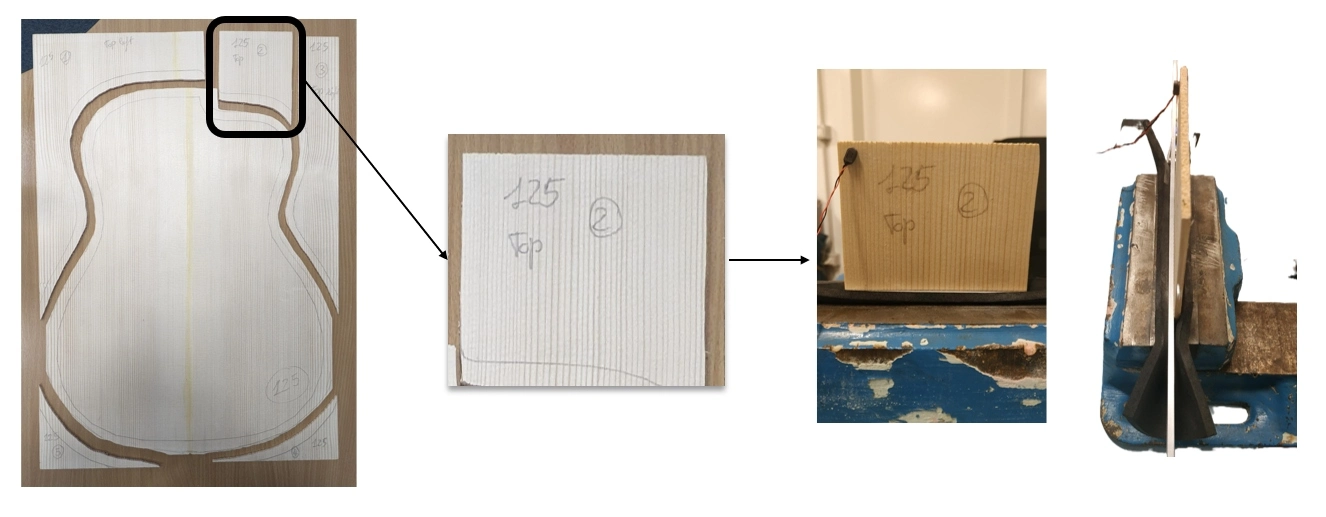 Fig. 1. From left to right: the shaped guitar top plate with the leftover sample identified; the extracted leftover sample; the sample clamped in cantilever boundary conditions (C-F-F-F) using a bench vise, with a foam layer to protect the surface.
The leftover was tested under cantilever boundary conditions — one edge clamped, the remaining three free — and its resonance frequencies identified using an impact hammer and accelerometer. Two independent measurement setups were used to assess consistency: a simple single-point setup with Audacity for spectrum analysis and Chladni patterns for mode identification, and a more instrumented setup with a roving accelerometer and BK Connect software for full modal reconstruction.
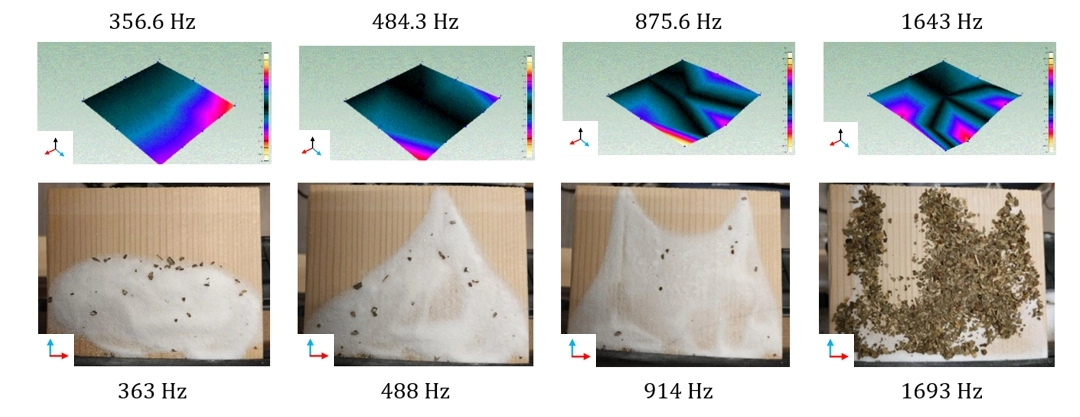 Fig. 2. Mode shape comparison between the two experimental setups on the guitar leftover. Top row: computed modal shapes from the instrumented setup. Bottom row: observed Chladni patterns from the simpler setup. Frequency differences between the two setups are below 3% across all identified modes.
The two setups returned elastic constants agreeing to within a few percent. The estimated longitudinal Young’s modulus was approximately 6.3 GPa, the radial modulus around 780 MPa, and the shear modulus around 535 MPa — consistent with typical values for red spruce. The small relative standard deviations (below 7% across all three constants) confirm that the estimation is stable regardless of measurement complexity.
Validating Against the Real Plate
With elastic constants in hand from the leftover, a finite element model of the full guitar top plate was built in COMSOL and its modal response computed. To check whether the leftover-derived constants actually predict the behaviour of the full board, experimental modal analysis was conducted on the shaped guitar plate under fully clamped boundary conditions.
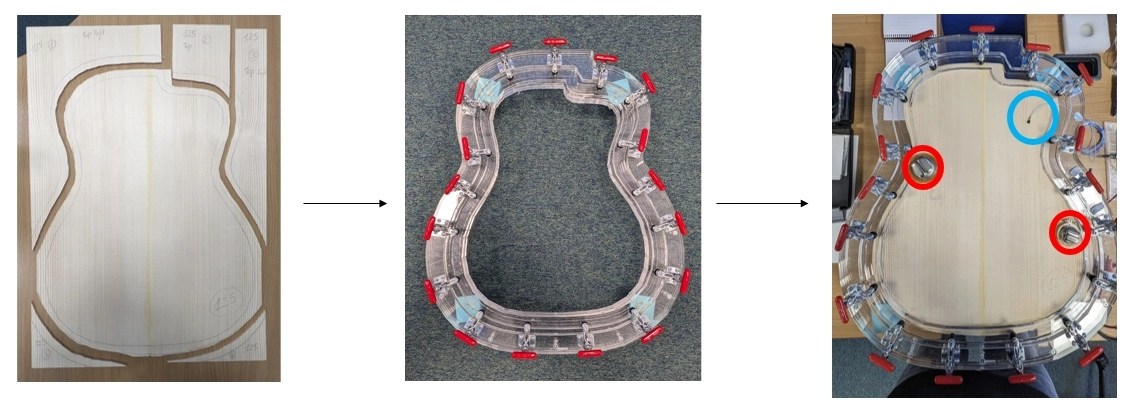 Fig. 3. The guitar top plate being prepared for experimental modal analysis. Left: the shaped plate. Centre: the custom plexiglass clamping frame. Right: the plate under fully clamped boundary conditions, with exciter positions marked in red and the accelerometer in blue.
The comparison between simulated and experimentally observed mode shapes is presented below. Chladni patterns were obtained on the clamped guitar plate to directly compare with the FEM predictions.
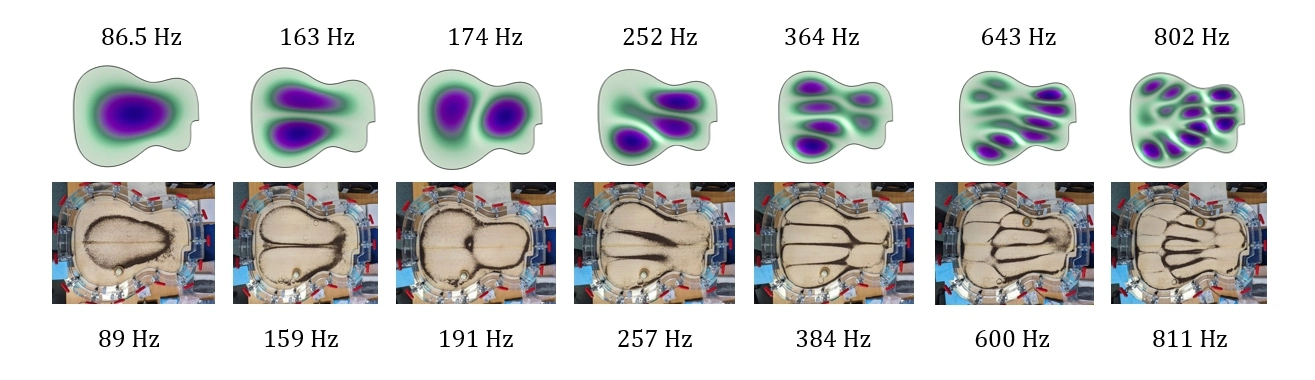 Fig. 4. Comparison of simulated eigenshapes (top row) and experimentally observed Chladni patterns (bottom row) for the guitar top plate under fully clamped boundary conditions. Frequency deviations range from 0.5% to approximately 9%, with a standard deviation of 3.1% across the seven identified modes.
For the guitar, the agreement is good. The mode shapes match well visually, and the frequency deviations — while not negligible — are within a range that would be acceptable for many practical applications.
Case Study 2: Concert Kantele Top Plate
The second case involved a concert kantele whose soundboard was assembled from multiple spruce planks glued side by side. A small rectangular offcut from one of the remaining planks — the same stock used in construction — was taken as the leftover sample.
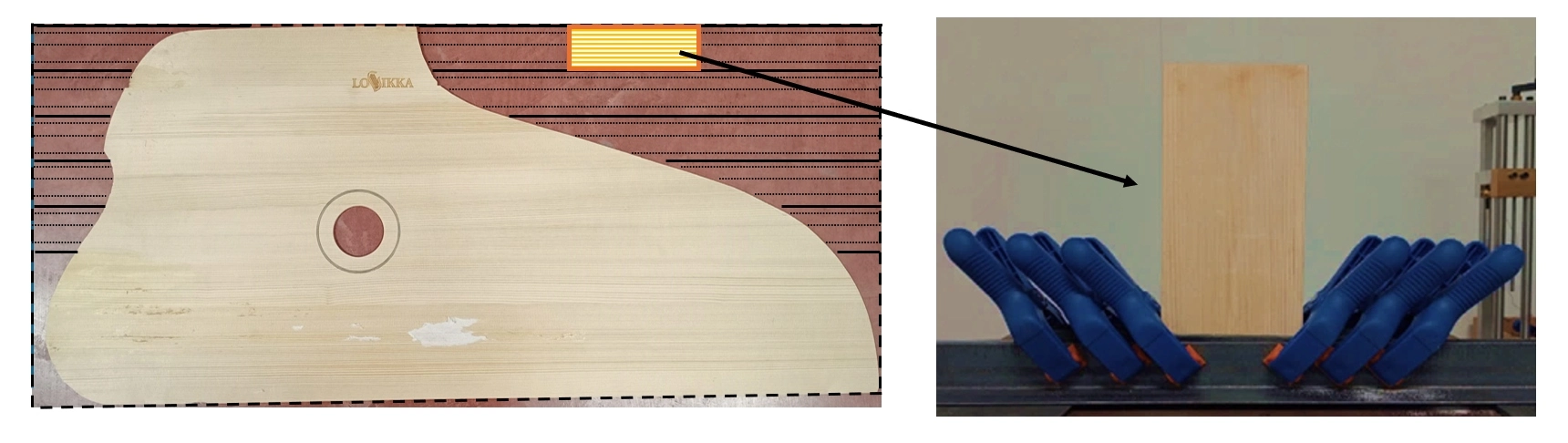 Fig. 5. The concert kantele soundboard (left) with the leftover sample highlighted, and the sample clamped in cantilever boundary conditions (right). The leftover comes from one of the spruce planks used to assemble the multi-part soundboard.
Elastic constants were estimated from the leftover using the same cantilever procedure as for the guitar case. The full kantele top plate was then measured using a laser Doppler vibrometer scanning over the freely supported plate surface.
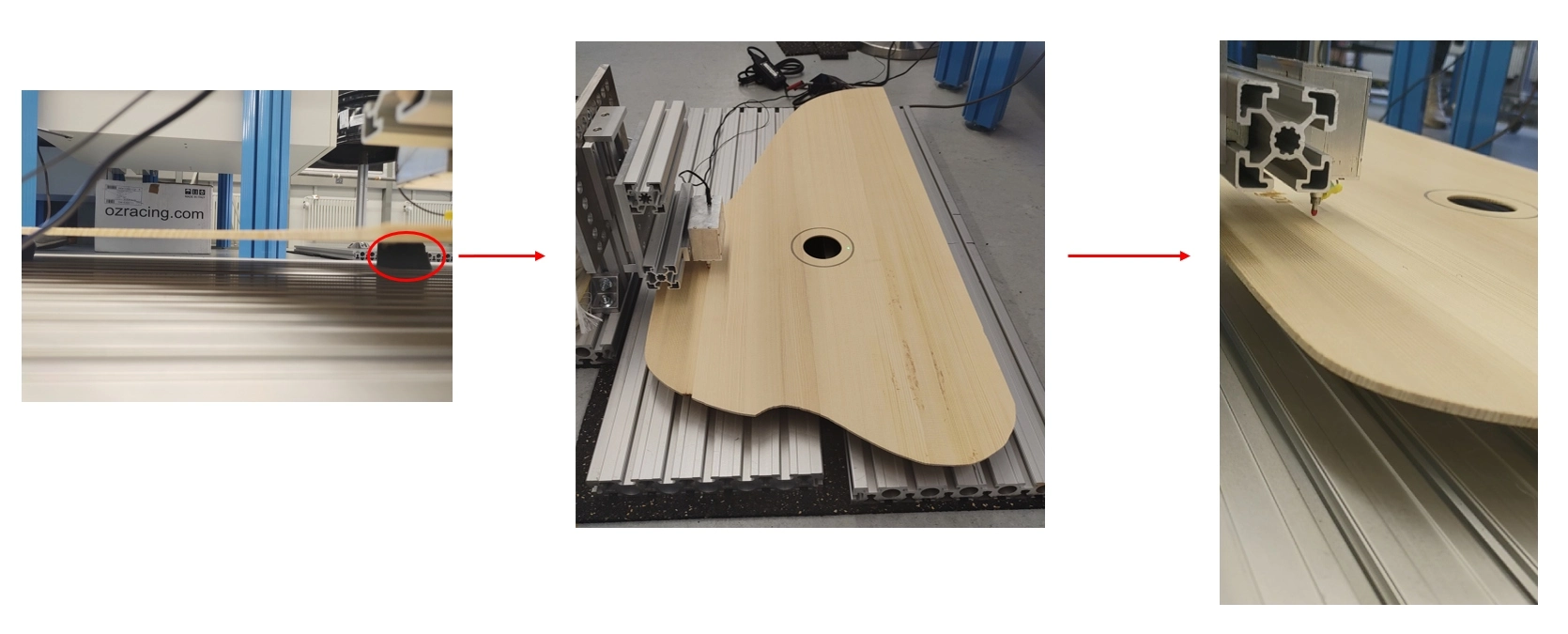 Fig. 6. Experimental modal analysis setup for the kantele top plate. The plate rests on foam supports to approximate free boundary conditions, and a scanning laser Doppler vibrometer records the velocity field over the plate surface.
The comparison between FEM predictions and measured modal shapes for the kantele is shown below.
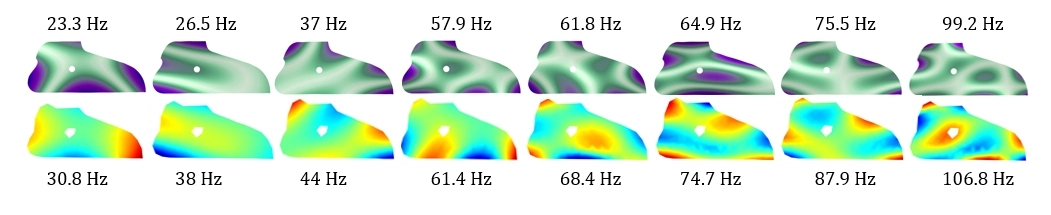 Fig. 7. Comparison of simulated eigenshapes from the kantele FEM model (top row) and experimentally measured modal shapes via LDV (bottom row). Frequency deviations range from 5.6% to 30%, with a standard deviation of ±8.4% — noticeably larger than in the guitar case.
The kantele results are less satisfactory. Frequency deviations reach up to 30%, and the mode shapes, while qualitatively similar in some cases, show clear discrepancies. Two factors likely contribute. First, achieving genuinely free boundary conditions experimentally is difficult; any residual contact with the foam supports can alter the lower modes appreciably. Second, and more fundamentally, the kantele soundboard is assembled from multiple planks, and the leftover came from just one of them. Natural wood variability — in grain angle, ring density, and local moisture content — means a single-plank sample may not be representative of the full board’s average elastic behaviour.
What This Means in Practice
The guitar case demonstrates that the leftover approach can work well when the soundboard is cut from a single homogeneous piece of wood and the experimental conditions are controlled. The kantele case highlights the limits: multi-part assemblies and the practical difficulty of ideal boundary conditions both introduce uncertainty that a single leftover sample cannot fully account for.
More broadly, the study raises a question that remains open: what level of modal discrepancy is actually tolerable when comparing two instruments or two numerical models? Defining just noticeable differences (JNDs) in the vibroacoustic behaviour of soundboards — analogous to perceptual thresholds in psychoacoustics — is a necessary step for turning numerical models into practical tools for instrument making and restoration.
The paper was presented at ASA/ICA 2025 and is published open-access in the Proceedings of Meetings on Acoustics, Vol. 56, 035010 (2025). DOI: 10.1121/2.0002084. This work received funding from the European Research Council under the NEMUS project (ERC grant 950084).
Sebastian Duran and Henna Tahvanainen are at the Department of Industrial Engineering, University of Bologna. Ludovico Ausiello is at the School of Electrical and Mechanical Engineering, University of Portsmouth. Michele Ducceschi is at the Department of Industrial Engineering, University of Bologna.