San Colombano Spatial Reverb: The Room Around the Instrument

The Trasuntino project asked how a historical instrument could be made playable without restoring the original object back into playing condition. The San Colombano Spatial Reverb begins with the next question: if we can recreate the instrument, what happens to the room around it?
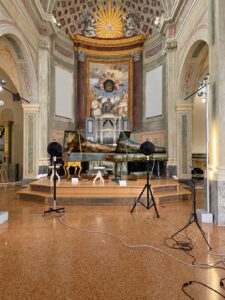 The 1547 Alessandro Trasuntino harpsichord is not an isolated object. It belongs to the Tagliavini Collection at Museo San Colombano in Bologna, surrounded by other historical keyboards and by the acoustics of the former church itself. A sample library or a physical model can reproduce the sound radiated by an instrument, but played dry it is still detached from the space in which visitors encounter it. The aim here was therefore to model the room as well as the instrument — not as a single fixed impulse response, but as a space through which the listener can move.
That makes the project a direct continuation of two earlier NEMUS case studies. From the Trasuntino work it inherits the idea that heritage can be copied numerically without compromising the original. From the Bunkervik Spatial Reverb it inherits the modal-reverberation framework that turns measured impulse responses into a real-time, position-dependent acoustic model. The difference is dimensionality, the Bunkervik was essentially one-dimensional but the San Colombano is a room.
Measuring San Colombano
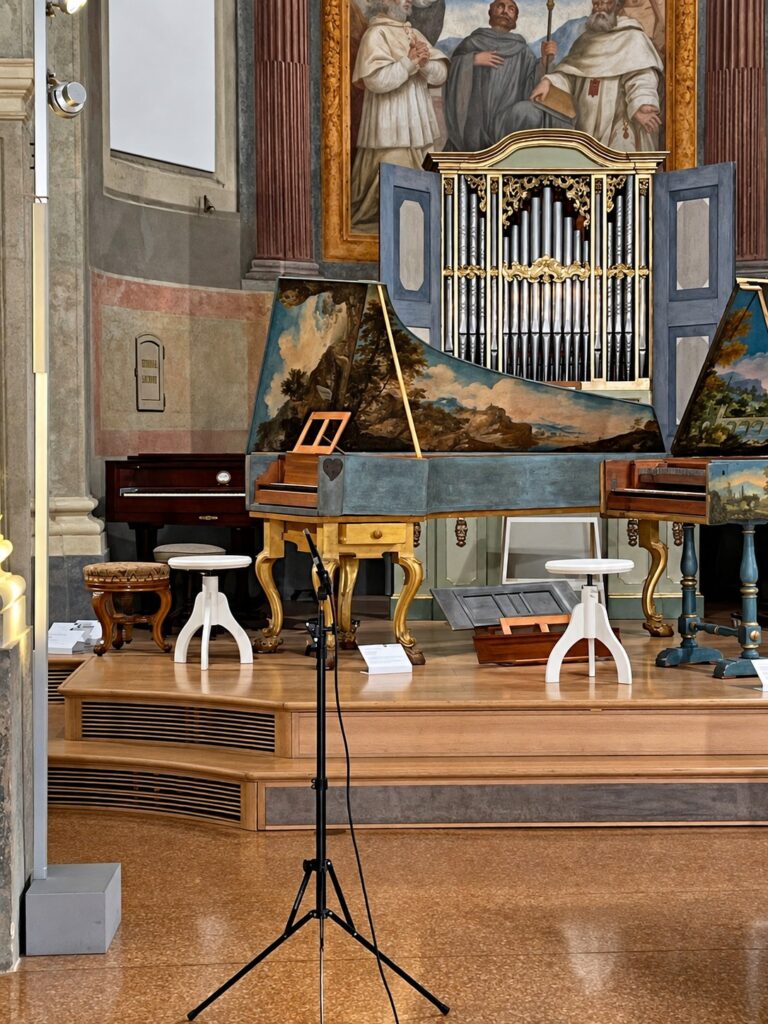
The measurement setup at the front of the hall. The spatial reverb ultimately fixes the virtual source at S5, in the presbytery, and allows the listener to move through the measured receiver field.
The measurement campaign was carried out in early May 2026 by Dr Giulia Fratoni, Dr Sebastian Duran and Dr Riccardo Russo. The procedure followed the impulse-response methodology used for performance spaces in ISO 3382-1: an approximately omnidirectional dodecahedral loudspeaker was used as the source, an omnidirectional microphone as the receiver, and exponential sine sweeps were played and recorded at a set of source–receiver positions distributed through the hall.
A sine sweep is useful because the room does not have to be excited by a literal impulse. Instead, a tone sweeps continuously across the audible band. After recording, the sweep is deconvolved with its inverse filter, collapsing the result into the room impulse response: the direct arrival, early reflections and long reverberant decay all laid out in time. The method gives a high signal-to-noise ratio and, because the sweep is deterministic, makes repeated measurements at many positions practical.
The San Colombano dataset contains five source positions, S1–S5, and thirteen receiver positions, R1–R13. Sources S1–S4 were measured against receivers R1–R9; source S5 was measured against all thirteen receivers. That produces 49 source–receiver pairs in total. The processed impulse responses in the development dataset are mono, sampled at 48 kHz.
The ISO analysis carried out on the measurements also gives a useful acoustic portrait of the room. For source S5, the average T30 is about 3.24 s at 500 Hz, 3.18 s at 1 kHz and 3.06 s at 2 kHz: a long, musically significant decay, but one that changes in level, timing and colour as the listener moves through the building. That spatial change is exactly what a single convolution impulse response cannot capture.
A map recovered from the measurements
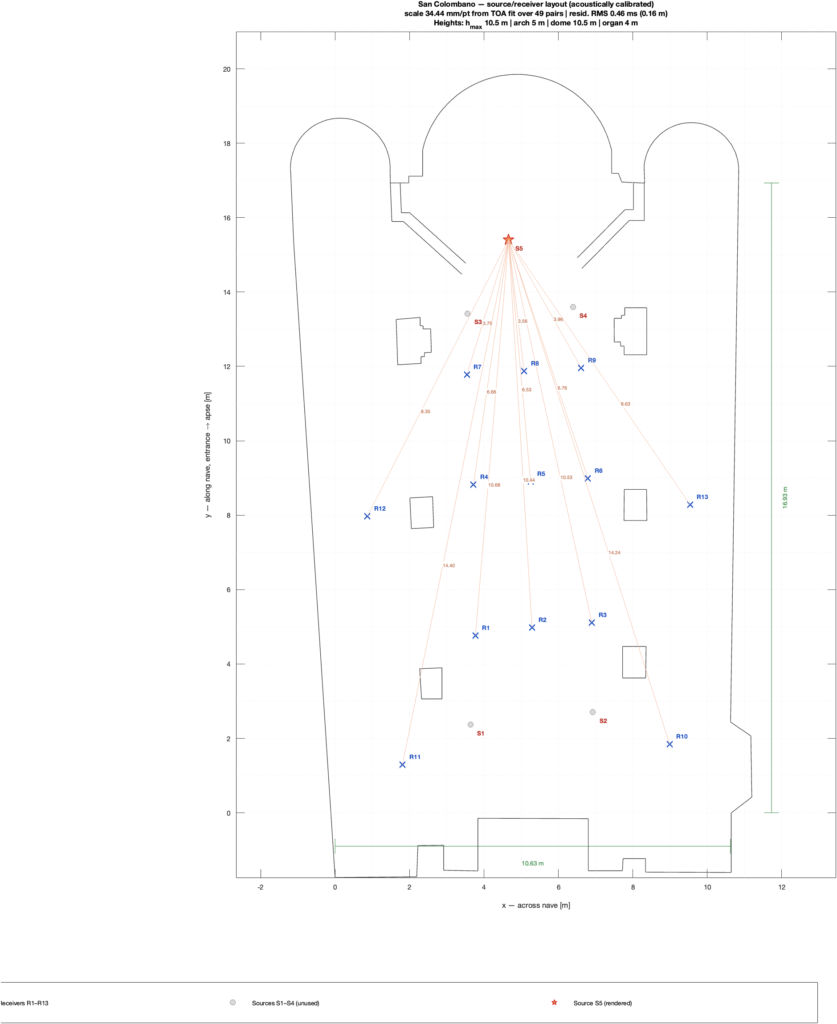
Source and receiver layout recovered by the MATLAB geometry stage. The five sources are marked S1–S5 and the thirteen receiver anchors R1–R13. S5 is the source used by the final spatial renderer.
The measurement plan presented a small but important problem. Its source and receiver marks were available as vector objects, so their centres could be recovered precisely, but the plan itself was explicitly marked as having been scaled by eye. In other words, it was geometrically useful but not metrically trustworthy.
The MATLAB pipeline solves that problem acoustically. The direct-sound arrival time in each measured impulse response gives a physical distance: sound travels from source to receiver at a known speed. The code therefore fits the unknown drawing scale and a small per-source system latency across all 49 measured source–receiver pairs. The result is a scale of about 34.44 mm per drawing point, with a residual RMS timing error of about 0.46 ms, equivalent to roughly 16 cm of distance.
That calibration turns the survey drawing into a metric coordinate system. The reconstructed inner width of the nave is about 10.63 m, while the distance from the counter-façade to the triumphal arch is about 16.93 m. More importantly for the reverb, every source and receiver now has a coordinate in metres, and the sound model can use the actual source–listener distance rather than an arbitrary position control.
Thirteen impulse responses, one room
The final reverb uses source S5, in the presbytery, and the thirteen S5 impulse responses measured at R1–R13. As in the Bunkervik project, each measured response is first represented as a sum of damped sinusoids — modes. Every mode has a frequency, a decay rate and a pair of residue weights that determine how strongly it appears at a particular receiver position.
The important separation is the same as before. The frequencies and decay rates belong primarily to the room; the residue weights depend on where the listener is. If every receiver can be expressed using exactly the same modal frequencies and decay rates, then moving through the room no longer requires replacing one entire impulse response with another. It only requires changing the weights attached to a fixed resonator bank.
The San Colombano MATLAB pipeline therefore fits the thirteen responses independently and then votes their poles into a common modal basis. The released development data contains an exact basis of 5,000 modes, extending from about 75 Hz to 10.1 kHz. Each of the thirteen receiver anchors then gets its own set of residue weights on those same 5,000 modes, plus a short 256-tap residual FIR filter to catch the part of the response that the modal bank does not reproduce efficiently.
The common-basis reconstruction is already close to the measured data: across the thirteen receiver positions, the stored normalised time-domain error is around 1.7% on average, with the individual positions remaining within roughly one to three per cent. The point is not that the room has been reduced to a single decay-time number. The point is that thirteen different measured responses have been rewritten in a form that shares the same underlying room dynamics.
From a line to a plane
This is where San Colombano departs most clearly from Bunkervik. Bunkervik could be treated as one-dimensional. Three measured listener positions sat along the axis of a tunnel, so movement could be described by a single coordinate and the modal weights could be interpolated along a line. San Colombano requires two coordinates. The receiver positions form an irregular cloud across the nave, and the listener must be able to move left and right as well as forward and back.
The solution in the MATLAB prototype is deliberately simple. The thirteen receiver anchors are connected by a Delaunay triangulation — seventeen triangles covering the measured region. At any instant, the listener position falls inside one of those triangles. The renderer finds that triangle and calculates three barycentric weights: one for each corner. Those weights are then used to blend the three neighbouring receiver descriptions — modal residues and residual FIR taps — into the acoustic response for the listener’s current position.
The geometry is therefore local. A listener does not crossfade between thirteen complete impulse responses. At any point, only the three anchors surrounding that point define the interpolation. Cross a triangle edge and the neighbouring triangle takes over continuously. A small amount of smoothing is applied to the interpolated parameters to prevent the piecewise-linear geometry from producing audible clicks during fast motion.
At the same time, the physical propagation delay is not interpolated from the measurements. It is recomputed from the actual Euclidean distance between the listener and source S5, sample by sample. The room colour comes from the interpolated modal field; the direct travel time comes from geometry. That distinction is important because it lets the listener move continuously without breaking the basic timing of the room.
The renderer also extends the model into stereo. Low-frequency energy is kept comparatively coherent while the higher modes are progressively decorrelated between left and right channels. A head-angle control changes the interaural balance of the source relative to the listener’s facing direction. The result is not a binaural room simulation in the strict sense, but a spatially responsive stereo reverb whose source direction, distance and reverberant field all change together.
Into the plug-in
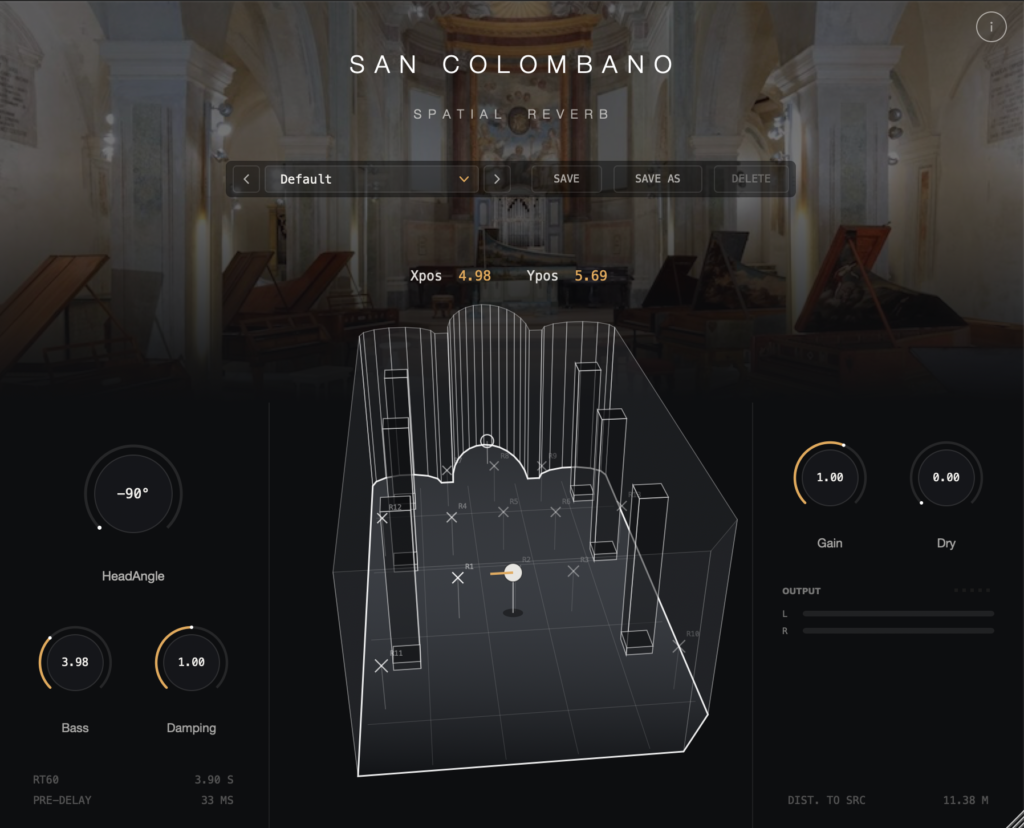
The San Colombano Spatial Reverb prototype. X/Y position moves the listener continuously through the measured room; the interface also exposes head angle, bass, damping, wet gain and dry level.
The MATLAB code is written as a prototype for a real-time implementation. The audio loop is intentionally organised around the operations that a C++ plug-in has to perform every sample: read the listener position, find the enclosing triangle, compute barycentric weights, interpolate residues and FIR taps, update the shared modal bank, apply propagation delay, and produce the stereo output.
That prototype became the San Colombano Spatial Reverb, developed by NEMUS with Physical Audio. The visual language deliberately follows the Bunkervik plug-in, but the central control is no longer a position on a line. It is a plan of the church. The measured receiver locations are visible in the room model, with the listener placed freely between them. This is the practical reason for doing the modal work rather than simply assembling a bank of convolution reverbs. The 5,000 resonators are built around one fixed common basis. Movement changes the weights and short residual filter, not the structure of the room model itself. The same underlying acoustic object can therefore be explored continuously in real time.
The plugin is free to download from the NEMUS software page, along with the rest of the project’s released tools.
Putting the room back around the Trasuntino
The project closes a loop that began with the silent 1547 harpsichord. The Trasuntino case study produced two complementary ways of hearing the instrument without restoring the original: a physical acoustic copy and a digital performance system, including the sample library already released by NEMUS and the physical model developed within the project. The San Colombano reverb adds a third numerical layer: the room in which the original instrument is preserved.
The next step is to bring those assets together. Instead of a generic reverberator placed after a harpsichord library or model, the instrument can be played into a measured model of its present-day museum environment. The dry instrument and the room remain independent — which is useful scientifically and musically — but they can be recombined into one experience: a model of the Trasuntino sounding inside a model of San Colombano. That is a slightly different kind of restoration. The object is not being reconstructed in isolation. A piece of its acoustic context is being reconstructed too.
From San Colombano to DAFx26
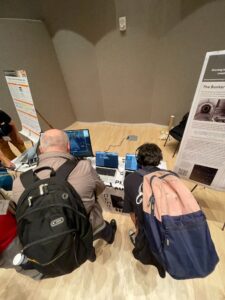
Demonstrating the NEMUS spatial reverbs at DAFx26, MIT, Cambridge, Massachusetts, September 2026.
The Bunkervik and San Colombano reverbs were taken to the 29th International Conference on Digital Audio Effects (DAFx26), held at MIT in Cambridge, Massachusetts, from 1–4 September 2026. Bunkervik was accompanied by the formal conference demonstration paper “Bunkervik Spatial Reverb Demo” by Craig Webb and Michele Ducceschi; San Colombano was presented alongside it as the next step from one-dimensional to two-dimensional measured spatial reverberation.
The most useful part of the presentation was not explaining the algorithm. It was letting people move the listener and hear the acoustic change immediately. A room impulse response normally looks like a fixed file. Here, the room behaved as a navigable object. The response at the demonstration table made the underlying idea unusually easy to communicate: instead of choosing which impulse response to load, the user simply moves through the space.
The DAFx demonstration also made the relationship between the two reverbs clear. Bunkervik proved that modal weights could carry spatial variation along one axis at very low computational cost. San Colombano shows that the same principle survives the jump to a real two-dimensional measurement grid — and, with it, to rooms whose acoustics cannot be reduced to distance alone.
What a room can become
The San Colombano Spatial Reverb is not an attempt to replace the museum or to claim that a plug-in is equivalent to standing in the church. It is a way of preserving one measurable layer of the place in a form that can remain active: analysed, modified, played, and combined with the digital instruments that NEMUS has already built.
That continuity matters. The project began by asking whether an historical musical instrument could remain materially untouched while becoming musically available. The same logic now extends outward from the object. A room, like an instrument, can be measured without being reduced to a photograph or a recording. Once its behaviour has been separated into a stable physical structure and position-dependent weights, it can be made interactive.
The Trasuntino gave us an instrument that could be played without touching the original. Bunkervik gave us a room that could be walked through in sound. San Colombano brings those two ideas together: the instrument, the room, and the listener all become variables in the same digital reconstruction.
Notes and references
The source/receiver geometry, numerical values and algorithmic description in this case study are drawn from the SanColombanoSpatialReverb MATLAB pipeline used as the numerical benchmark for the project, its calibrated geometry output, common-basis data and ISO 3382-1 analysis workbook.
- NEMUS, The 1547 Trasuntino Harpsichord: Digitising the Unplayable.
- NEMUS, Bunkervik Spatial Reverb: A Room, Discretised.
- ISO, ISO 3382-1:2009 — Acoustics — Measurement of room acoustic parameters — Part 1: Performance spaces.
- DAFx26, 29th International Conference on Digital Audio Effects, Cambridge, MA, 1–4 September 2026.
- C. Webb and M. Ducceschi, Bunkervik Spatial Reverb Demo, Proceedings of DAFx26.
- NEMUS, Software Downloads.
Acknowledgements. The authors thank the Tagliavini Collection at Museo San Colombano, Genus Bononiae and Fondazione Carisbo for access to the venue and its instruments. The San Colombano measurement campaign was carried out by Dr Giulia Fratoni, Dr Sebastian Duran and Dr Riccardo Russo. The real-time plug-in was developed by NEMUS in collaboration with Physical Audio.