The 1547 Trasuntino Harpsichord: Digitising the Unplayable

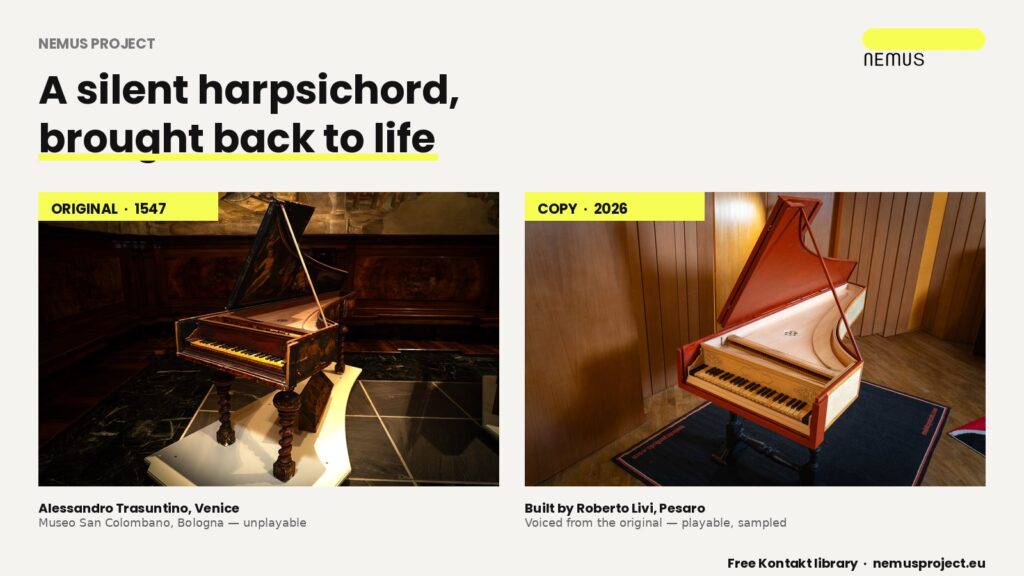
This is the central case study of the NEMUS project: the story of a single instrument that could not be restored, and what we did instead. The 1547 Alessandro Trasuntino harpsichord is among the oldest and most important Italian harpsichords in existence. It is also cracked, pierced, and silent. Rather than return it to playing condition — which would mean destroying the very evidence that makes it valuable — we built two faithful copies of it: one in wood, and one in numbers, played from a keyboard that makes no sound of its own. What follows is an account of how an unplayable museum object became, at the same time, a playable instrument, a measurable acoustic model, and a keyboard that any visitor to the museum can sit down and play.
The post moves through the problem and its history before describing the build, because the technical decisions only make sense against the long, unresolved argument about what a museum owes a historical instrument. We begin with that argument.
Why an instrument might need restoring at all
It is worth starting with a question that sounds naïve and is not: why would an instrument ever need restoring? The answer exposes a genuine tension at the heart of instrument conservation, one that the rest of this project attempts to resolve.
An instrument exists to be played. A violin that never sounds, a harpsichord behind glass — these are, in an obvious sense, doing only half of what they were made to do. Yet a historical instrument is also a document. It is the physical record of how a particular workshop, in a particular year, solved the problem of making music: the wood it chose, the thicknesses it left, the geometry it scribed, the tools it used. Every time the instrument is played, a little of that record wears away. Quills break and are replaced; leather perishes; strings are renewed at modern tensions; regulation drifts and is reset. None of these acts is vandalism, but each substitutes a modern part for an original one, and over enough cycles, the instrument becomes a description of its restorers rather than its maker.
This is not an abstract worry. The degree to which restoration is acceptable has been the subject of a long and unsettled debate among conservators, with serious voices on both sides [1, 2]. The “Early Music” revival of the early twentieth century sharply increased demand for original instruments [3], and for a museum holding a collection of them, the temptation was strong: a playable instrument draws crowds, sounds in concerts, teaches students. A silent one sits in a vitrine. For decades, the question was resolved, almost everywhere, in favour of playing — and the consequences of that choice are the reason the field changed its mind.
Cristofori, twice: one maker, two fates

The clearest way to see how the argument shifted is to follow two instruments by the same maker, restored sixty-two years apart, to opposite ends.
In the late 1930s the Metropolitan Museum of Art in New York drew on Dr Curt Sachs — the musicologist and former director of the musical-instrument collection at Berlin’s Staatliche Instrumentensammlung — as an adviser on the care and restoration of a collection that had been assembled half a century earlier and then left to languish [4]. Sachs is one of the founding figures of modern organology, and the prevailing practice of the time was clear: instruments should be restored to playing condition. A programme of restorations duly followed.
Among the instruments restored was the 1720 Cristofori piano — the oldest of only three surviving pianos by Bartolomeo Cristofori, the Italian inventor of the instrument. The modifications were not minor. The original soundboard was replaced with a copy of the same dimensions but made of a different wood: American swamp cedar, in place of the Mediterranean cypress Cristofori had used. The playing range was shifted upward by half an octave. The piano has been kept in playing condition ever since, and it still plays — but, as Wraight has observed, very little can now be said about its original sound, which is permanently lost [5].
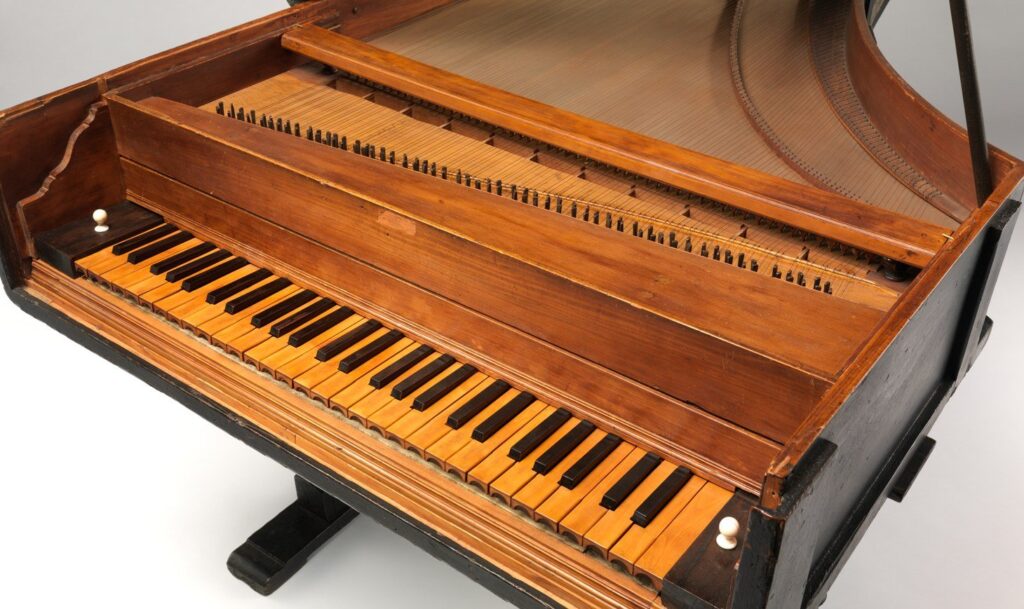
The 1720 Cristofori piano. The Met, 89.4.1219.
Now follow the same maker forward sixty-two years. In 2000, another Cristofori instrument surfaced at Palazzo Bardini in Florence: an oval spinet built in 1690, the oldest of the eleven surviving instruments from his workshop. It was moved to the Museum of Musical Instruments at the Accademia Gallery. In 2002, the museum convened a conference on the spinet’s conservation — and instead of announcing a restoration, it revealed a copy, having decided to keep the original in its found state with only minimal consolidation. The musicologist Grant O’Brien is credited in particular with opposing the restoration of the spinet [6]. Crafted by the same hands, the piano and the spinet are both outstanding witnesses to the ingenuity of one of the masters of the Italian tradition. Their fates could hardly be more different.
The six decades separating these two decisions were exactly the years in which the ethics of conservation changed — and not only for musical instruments. The 1960s produced a wave of recommendations and codes discouraging intrusive, irreversible treatment: most famously the 1964 Venice Charter on the conservation of monuments and sites [7], and the 1963 code of ethics of the American Institute for Conservation [8]. It is plausible that commercial ambition was a primary driver of the restoration agenda of the early twentieth century; that, at least, is the view of several later curators and restorers. John Barnes put the objection memorably, asking whether restoration does not in fact destroy evidence [9].
To play, or to preserve?
Today, restoration to playing condition is considered acceptable only under special circumstances [10–13], and the debate is not yet fully settled [14]. But the centre of gravity has moved decisively, and the arguments that moved it are worth stating in their own terms, because they are precisely the arguments NEMUS is built to honour.
Writing of the Ruckers double virginal in the Metropolitan Museum — an instrument missing several parts, including its strings — Pollens argues that even by visual inspection one can still imagine how it sounded [15]. Restoring it to play would almost certainly mean replacing ancillary parts such as quills and cloth, and those parts are themselves documentary evidence about the instrument and its making. Visual, tactile, and design cues can reveal as much about an instrument and its maker as its sound. Watson captured the principle in a phrase that the project has more or less adopted as a motto: a non-restored instrument should be regarded not as a derelict but as a pristine document or a treatise [16].
Cary Karp, embracing the same idea, proposed shifting effort away from restoration and toward preservation and documentation [17] — with the explicit aim of making historical instruments as copyable as possible [18]. Read carefully, Karp is arguing for a richer understanding of the instrument as a whole: not only its shape but its acoustical and musical behaviour. Lambrechts-Douillez states the emerging consensus plainly: “it is becoming increasingly accepted that museums should make copies of their own instruments, so that an impression of the sound can be given while preserving it” [2].
This is the consensus NEMUS inherits. And it is worth being honest about the limitations of the standard answer — the physical replica. Replicas, when informed by knowledge of the original, serve their purpose well, and there is substantial craft literature on how to make them [19]. But they have problems of their own. They require constant care; they are expensive; they are not easily portable; they can only be played by trained musicians; and they have a finite life. In time, maintaining a replica becomes as troublesome as maintaining the original. A copy is the right instinct. The question NEMUS asks is whether a copy must be only a physical object — or whether part of it can be made of numbers.
The instrument
The harpsichord at the centre of this project is held in the Tagliavini Collection at Museo San Colombano in Bologna — a collection founded by the organist and scholar Luigi Ferdinando Tagliavini on a strict principle: it admits only instruments that play, or that minimal, non-invasive work can return to playing condition. The Trasuntino is the single exception. It entered the museum in 2020, three years after Tagliavini’s death — the only acquisition made after his lifetime — and the question arose at once: should it be restored to play? The answer was no, and the reasons are the subject of this section.
The instrument is attributed to Alessandro Trasuntino and dated 1547. That date is not a paleographic guess: it is documented from the inlaid dedicatory inscription forward through the Medici archives. It makes the harpsichord the oldest known Italian instrument with two eight-foot registers, and the tenth-oldest dated harpsichord of any kind, according to Wraight’s 2022 report, commissioned by NEMUS [28].
The instrument’s signature is a puzzle in its own right. On the back of the nameboard — where it would not normally be seen — is a poorly written inscription, “Bortolus fecit.” On the front is something quite different: the patron’s epigraph, the arms of Ercole II d’Este, fourth Duke of Ferrara, executed as a flawless inlay reading HER · II · FER · DVX · IIII · CAR · I. But the signature names “Bortolus” — Bartolomeo, not Alessandro — so the attribution to the Alessandro Trasuntino workshop does not rest on it, but on the morphology of the instrument and on Giuliana Montanari’s archival research. Alessandro himself would have been about 65 in 1547; his successor, Vito — born Frassoni, then aged 21 — was very likely already working in the shop, so the instrument may be substantially Vito’s.
The name “Bortolus” is intriguing for a reason that points away from the original Venetian making. As the Dizionario Biografico degli Italiani records, in Florence — where the harpsichord spent its long Medici century — Bartolomeo Cristofori was known as “Bortolo,” and he is documented as the man the grand prince Ferdinando entrusted with maintaining and restoring the court’s instruments. The rear inscription may therefore be a trace of a later Florentine hand rather than the mark of whoever built the instrument in 1547. It is a useful caution against reading too much into a name scratched on the back of a board.
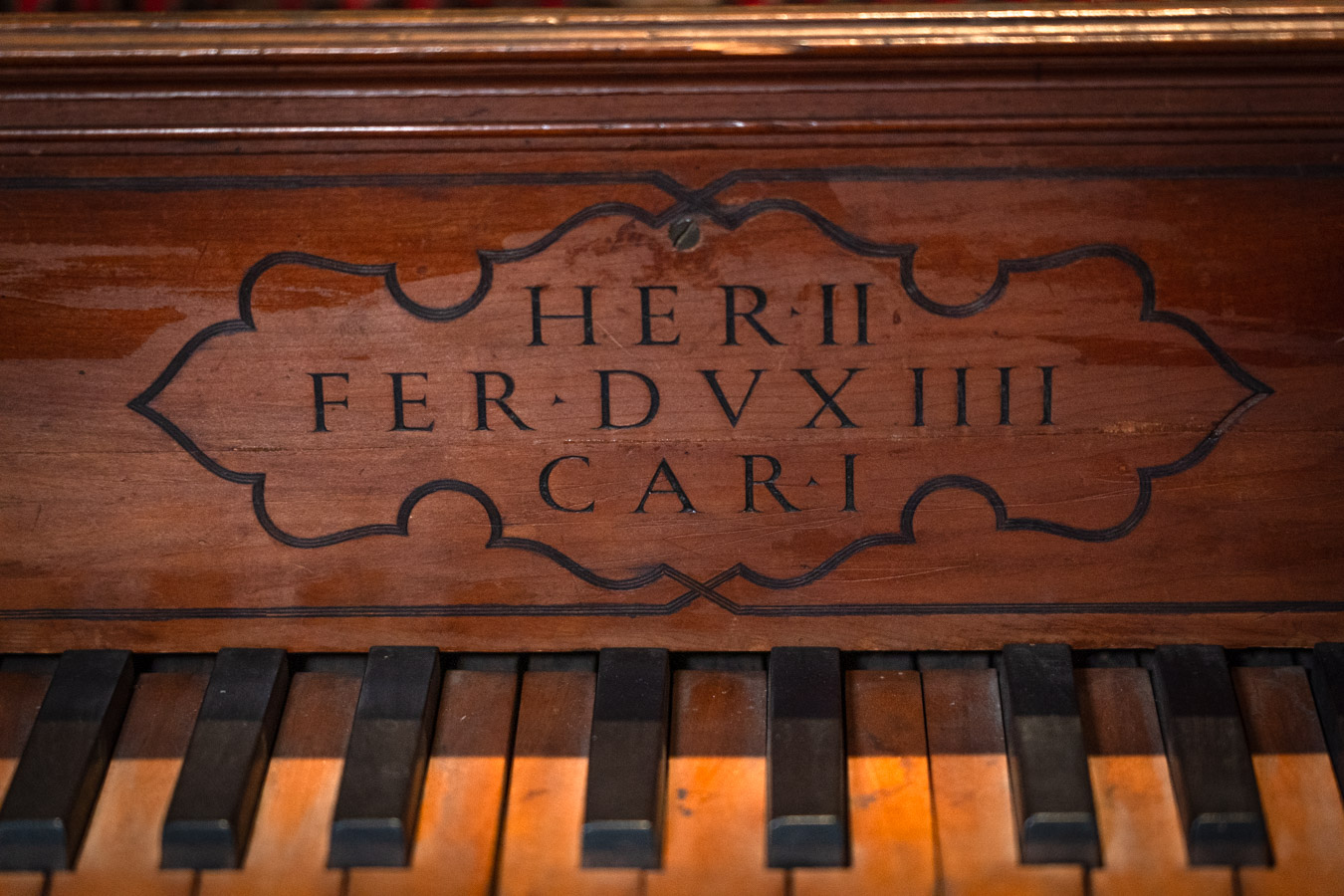 The dedicatory inlay to Ercole II d’Este, Duke of Ferrara, on the front of the nameboard.
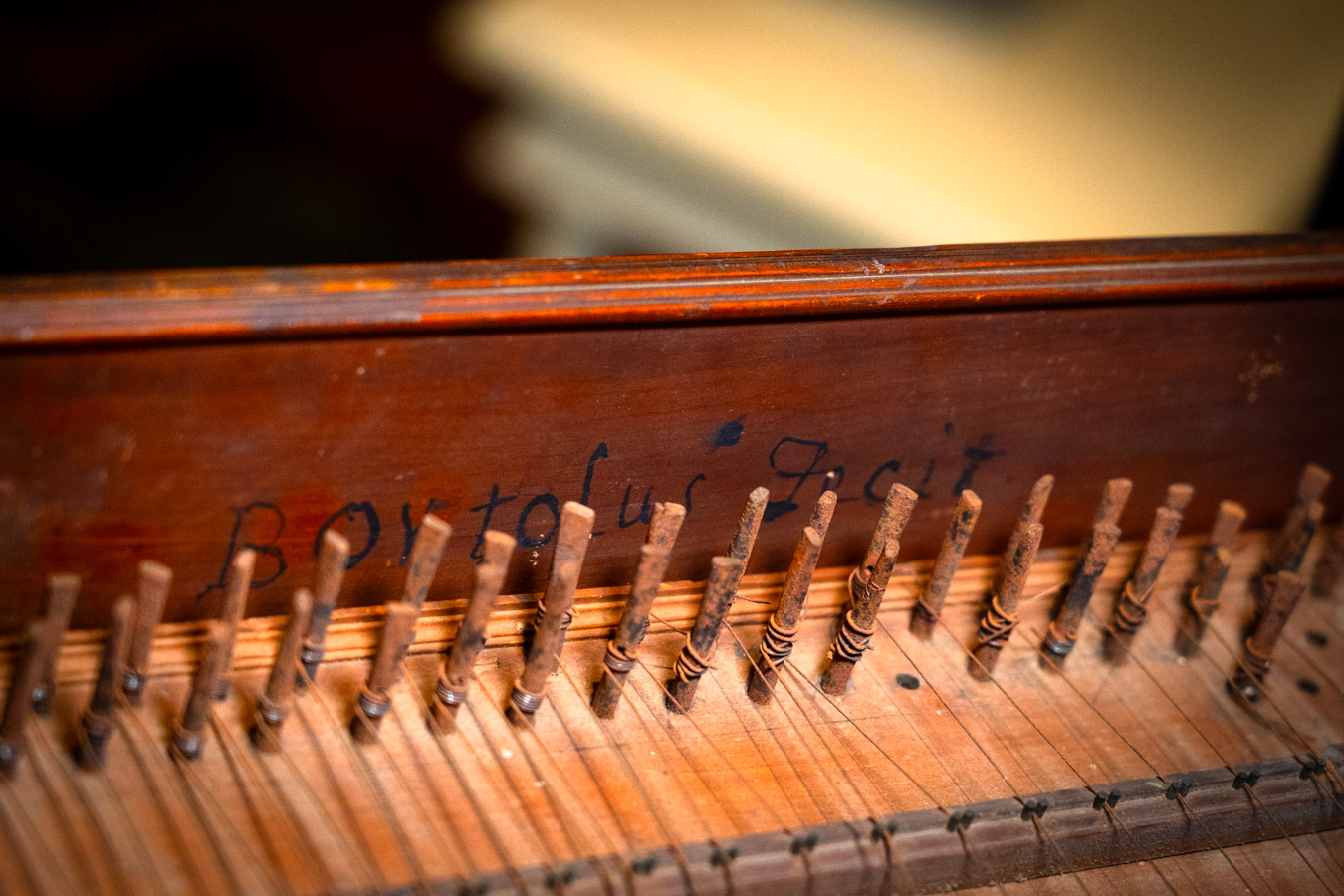 The signature on the back of the nameboard, “Bortolus fecit.” This has led some to suggest that Bartolomeo Cristofori (“Bortolo”) was involved with the instrument during its time at the Medici court — though this is speculative.
What sets the instrument apart is the state of its evidence. In his 2022 report for NEMUS [28], building on the author’s longstanding research, Denzil Wraight established that the soundboard has never been removed from the case and therefore has never been thinned. Thinning — shaving wood from the underside of an ageing soundboard in the belief that it would brighten the tone — was the standard “improvement” of the eighteenth and nineteenth centuries, and most surviving Renaissance soundboards have been thinned at least once; many have been replaced outright. The Trasuntino harpsichord’s soundboard is original 1547 cypress, at its original thickness, still neatly glued in position. The bridge is original and in its original location, confirmed by the vertical angle of its pins and the match between its mouldings and those of the 1538 Alessandro Trasuntino harpsichord in Brussels. The case, nameboard, and rose all survive from the instrument’s first state.
Four details, and a decoration
Stand in front of the instrument, and something looks off. The soundboard is the obvious wound — cracked and pierced, impossible to miss. But the more telling clues are quieter, and to a slightly more expert eye, three of them read as red flags: details that no Venetian workshop would have built into a harpsichord in 1547 and that betray how heavily the instrument was altered in the centuries that followed.
The first is the split sharps in the bass — the lowest accidentals divided front-to-back so that each key gives two separate pitches. The original 1547 harpsichord had a plain 45-note keyboard; these tasti spezzati were cut in only after 1714, when the compass was reworked. The second is the arcades on the key fronts, glued on upside down. No maker decorates a keyboard inverted on purpose — Wraight calls the inverted arcades a remarkable testimony to a poor level of competence — so the orientation gives away a later, clumsier hand redoing the key fronts, most likely during the twentieth-century repairs. The third is a small second nut, added beside the original one when the compass was reworked after 1714 to carry the new split-sharp strings; an instrument still in its original 45-note state would have no use for it.
None of these is original, and that is exactly the point. Read together, they are the visible symptoms of the fact that this whole case study turns on: the object in the case is not one 1547 harpsichord, but an instrument that was re-keyed, re-pitched, and rebuilt over four centuries.
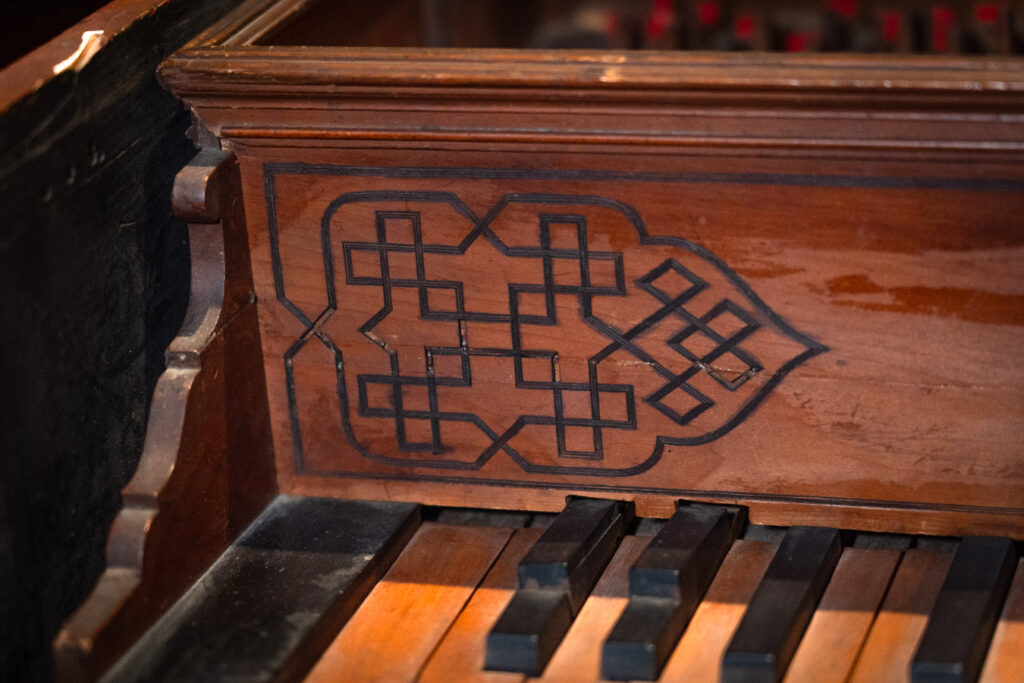
Split sharps in the bass — divided accidentals, cut in after 1714. Not part of the original 45-note keyboard.
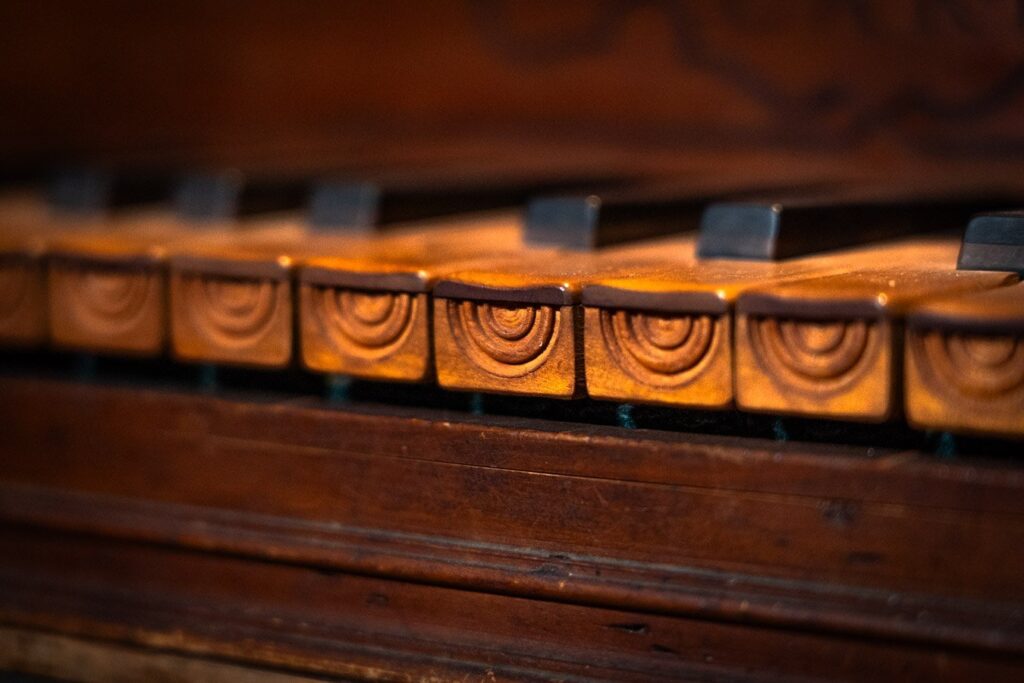
Arcades on the key fronts, glued on upside down — the mark of a later, clumsier hand redoing the keys.
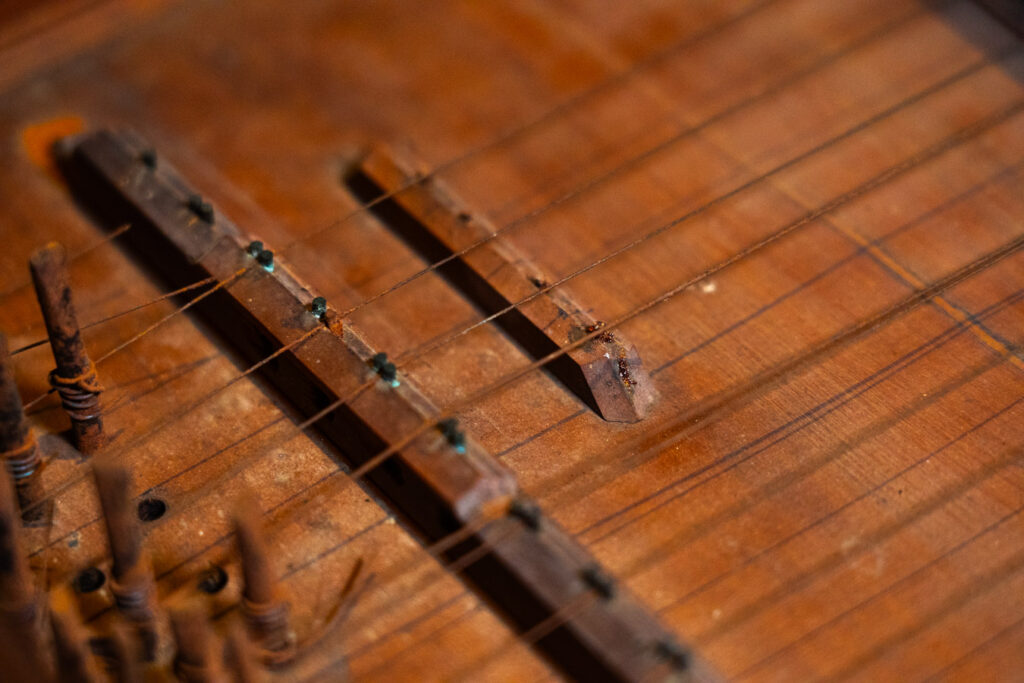
A small second nut beside the original, added when the compass was reworked after 1714.
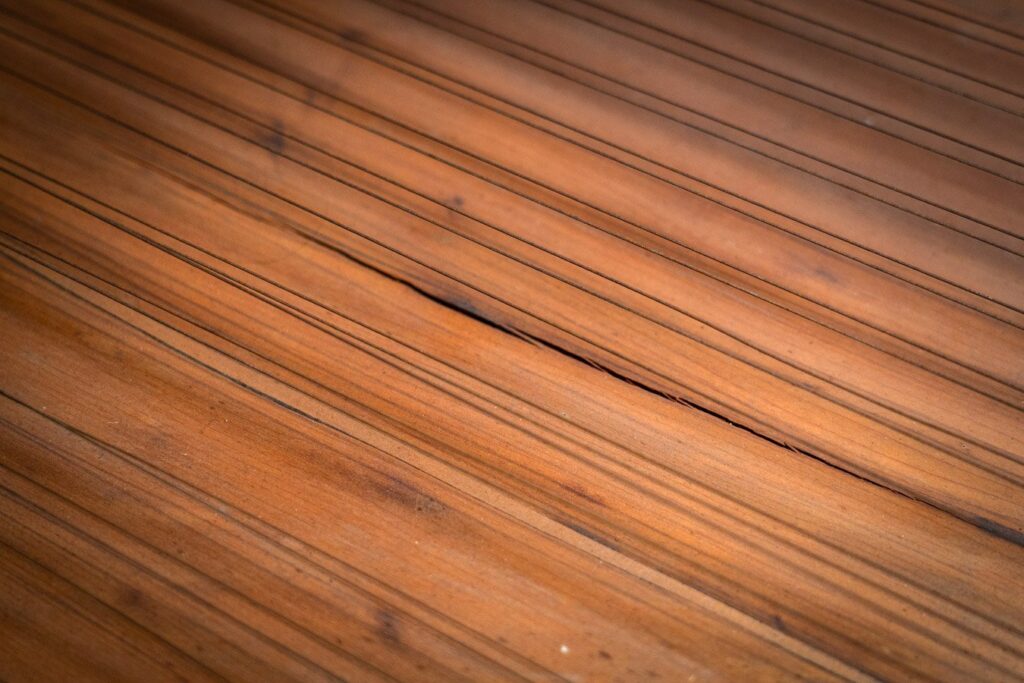
The soundboard: cracked and pierced — yet never removed and never thinned, original 1547 cypress.
Not every oddity is a later wound, though — and one unusual feature is original, the very thing that dates the instrument and ties it to its maker. The two strings of each note were first set remarkably close together, in pairs of roughly four millimetres against a more typical ten. That cramped spacing is an early, soon-abandoned way of building, and to reach a jack on each side of so narrow a pair the original keylevers had to be bent into a serpentine S-shape. The original S-keys are long gone — and the close pairs were widened when the keyboard was rebuilt before 1657 — but the balance-pin holes in the keyframe and the string lines scribed on the baseboard still record that first design exactly. The same close pairing and S-levers appear in the 1596 Celestini; a related Trasuntino instrument in Schloß Köpenick shares the S-levers and the inlaid decoration, though with single strings rather than the close pair — a workshop signature, not an aberration.
There are also square holes in the wrestplank, the upper bellyrail, and the jackslides — three unusual locations that share this feature with the 1538 Alessandro Trasuntino harpsichord. (It was these square holes that allowed Wraight to attribute the instrument in 1997, before Montanari’s archival confirmation.) Their function is not fully understood; Wraight suggests they may have let square pegs lock one register off while the other played — an early form of register on/off control.
The decoration is a record in its own right, and one that has to be preserved as carefully as the structure. The case carries pastoral scenes, retouched over the centuries; the underside of the lid bears a sixteenth-century painting; the rose is built up from layered Gothic parchment. Crucially, the later retouching is part of the object’s history too. Conservation here does not mean stripping the instrument back to 1547 — it means keeping every layer, including the clumsier interventions, because together they are the document.
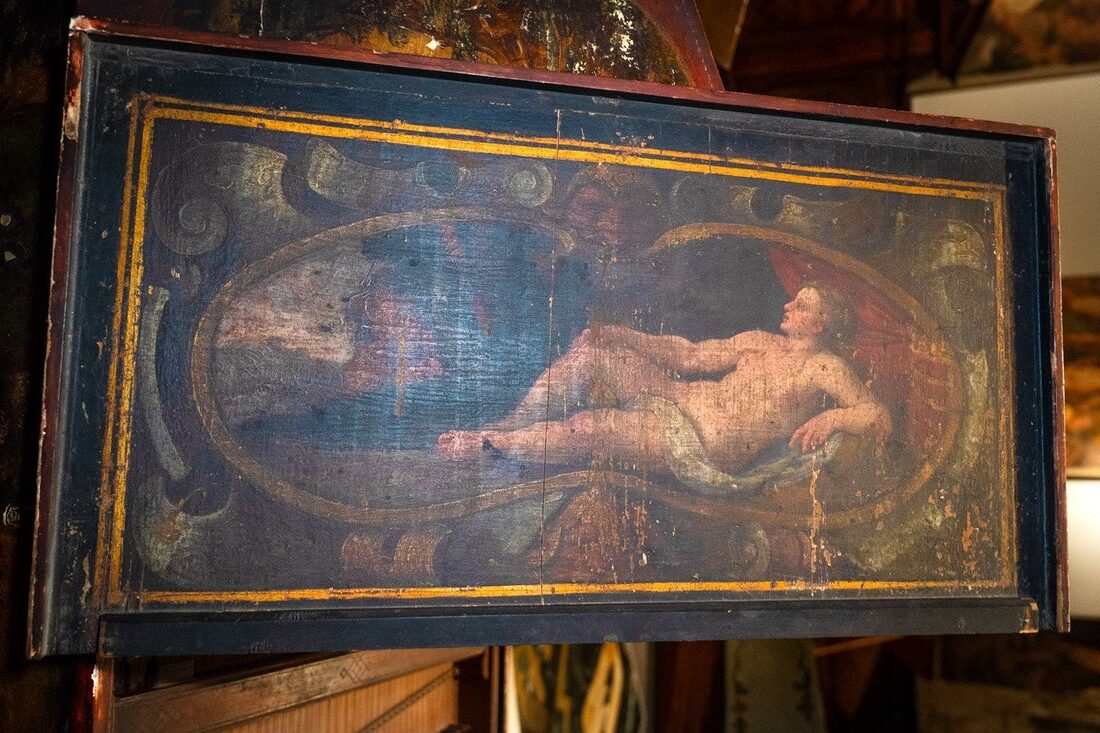
Sixteenth-century painting on the underside of the lid.
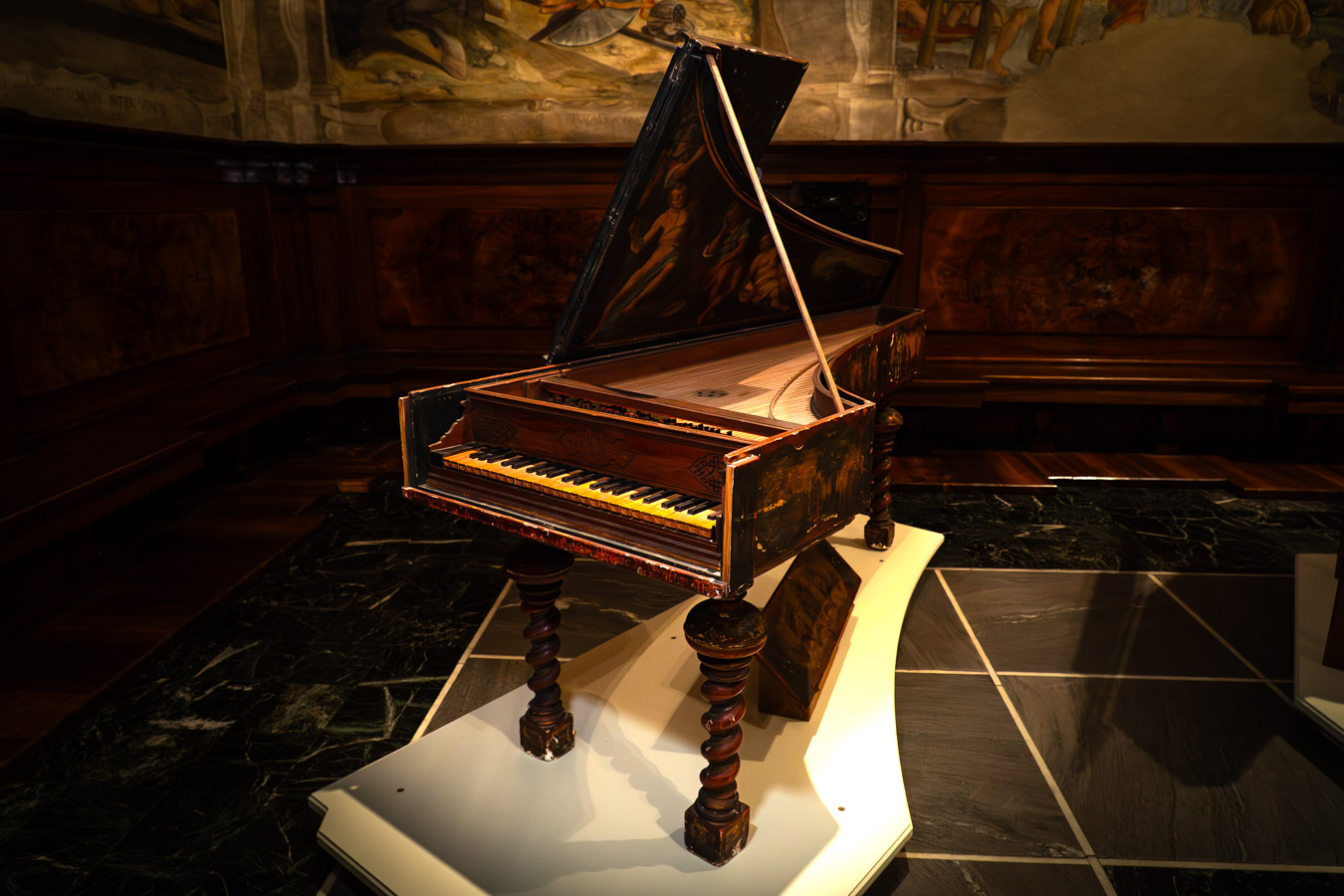 The 1547 Trasuntino in the San Colombano Oratorio
An original that was never one thing
There is a deeper problem hidden within the word “restoration,” and it must be confronted directly because it is the strongest argument against restoring this instrument. The Trasuntino was never one fixed object. It passed through at least four distinct, documented states, plus a twentieth-century episode — and a restoration would have to choose one of them and erase the rest.
The provenance alone is a four-century journey across Europe and back.
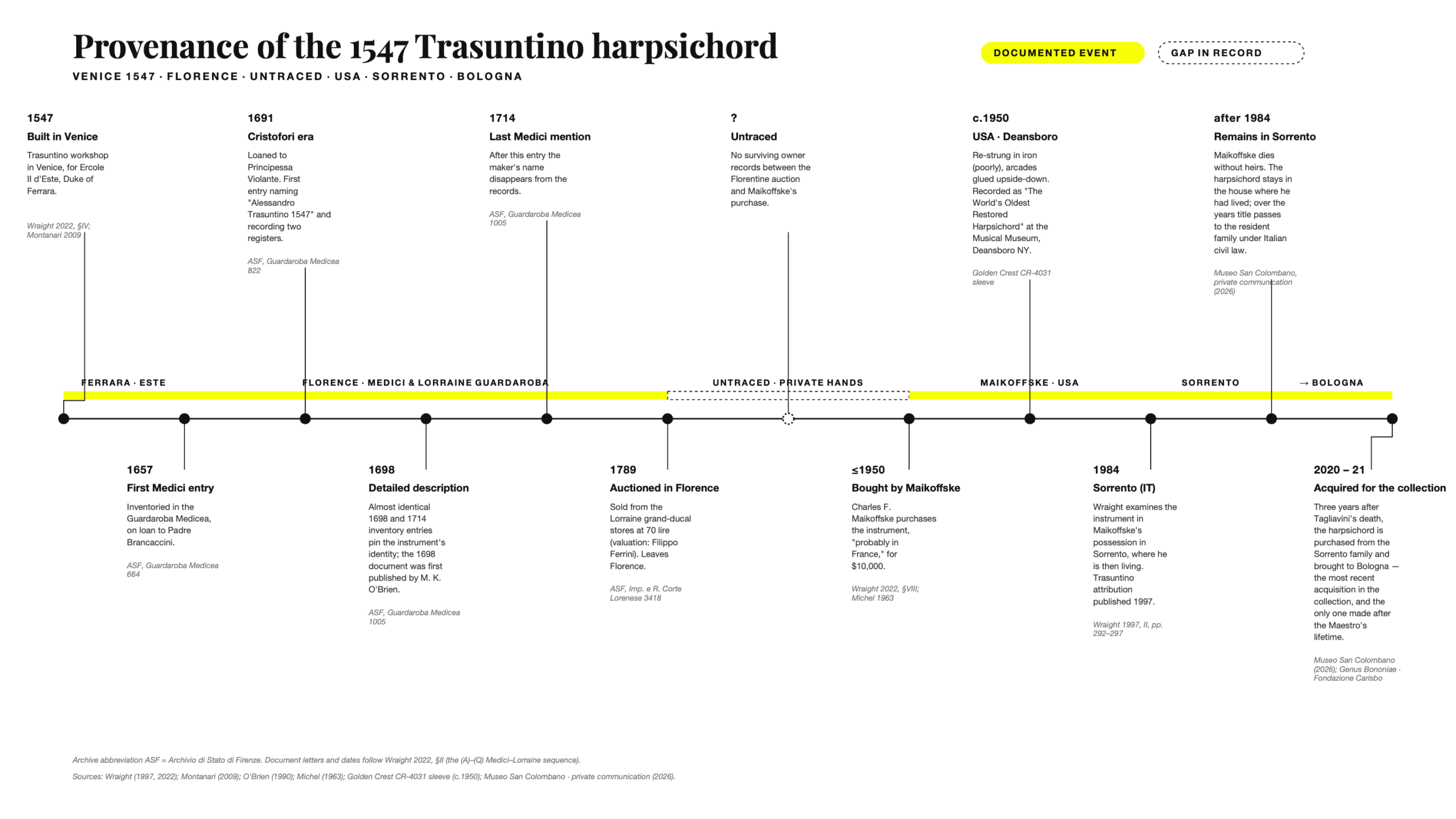 From Venice to Bologna, by a long road. Sources are shown on the diagram.
Built in Venice in 1547 and made for Ercole II d’Este in Ferrara, the instrument spent roughly a century and a half in the Medici Guardaroba in Florence, where it appears in twelve inventory entries before being auctioned in 1789. After that, the trail goes cold — “purchased in France,” is all Michel records — until it surfaces in the United States in the early 1950s, in the hands of Charles F. Maikoffske of Deansboro, New York. Wraight examined it in Sorrento in 1984; today it is in Bologna.
The instrument’s physical states map onto that journey. As built in 1547, it had iron strings, a 45-note compass, and the S-shaped levers. Before 1657, in Florence, it was re-pitched to brass, stringing a whole tone lower, with a new nut and a new keyboard — a modification Wraight reads as ordinary Florentine practice of the period, not the work of any one named hand. After 1714, the split sharps were added. After 1789, the treble was extended. Then comes the modern episode: in the early 1950s, Maikoffske re-strung it in iron at the wrong tension and recorded it.
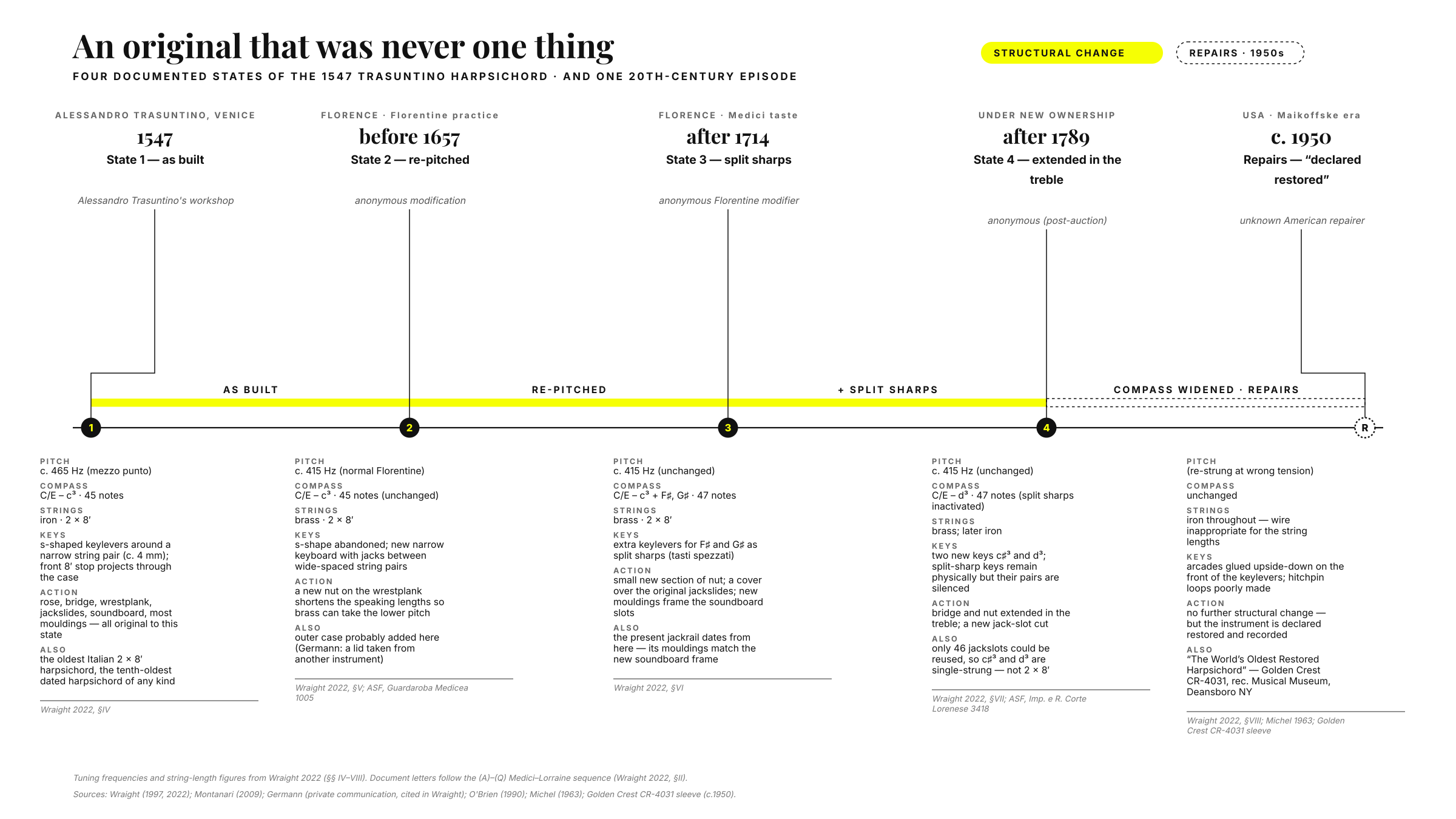 Four documented states and one twentieth-century intervention. Tuning and string data after Wraight 2022.
That 1950s recording is worth dwelling on because it is a small monument to the very problem the project addresses. The disc — issued on Golden Crest CR-4031 — bills the instrument as “the world’s oldest restored harpsichord,” with a programme of Greensleeves, Blue Bells of Scotland, Soldier’s Joy, and Modal Variations on a French Air, played on iron strings strung to a tension the instrument was never designed for. What the record preserves is not the 1547 instrument. It is the 1950s intervention. It is a recording of a restoration, mistaken for an original recording.
So the question on the nameboard — is this object a faithful representation of itself, as Alessandro Trasuntino conceived it? — has an uncomfortable answer. After four states and a transatlantic rebuild, “itself” is not a single thing. A restoration would not recover the original; it would manufacture one more state and present it as the truth. The honest response is not to restore at all, but to copy — and to be explicit about which state is being copied.
The decision: copy it, twice
So we did what Florence did with the oval spinet and doubled it. The plan was two copies, each answering a different question.
The acoustic copy asks whether the Trasuntino can be heard again — built in wood, to the original’s measured geometry and materials, by a master harpsichord builder. The digital copy asks whether anyone can play the instrument faithfully without ever touching the original — a physical model of the instrument, played through a second keyboard that produces no sound of its own and serves only as a control surface.
Why two, and why a silent keyboard? Because the feel of an instrument is part of the instrument, and the feel contaminates the sound. Expert players consistently report that sampled historical instruments feel wrong, and that the wrongness bleeds into how the sound itself is judged. Our PhD student Matthew Hamilton named this the tactile McGurk effect, after the celebrated audiovisual illusion of McGurk and MacDonald, in which seeing a speaker mouth one syllable while hearing another makes you perceive a third [27]. The original effect is about vision overriding hearing; the tactile version is about touch doing the same. On a generic plastic controller, even a perfect sample reads as plastic. The way around it is to drive the model from a keyboard with the original’s own action — and that is the harder of the two copies, so we describe the wooden one first.
Building the acoustic copy
Construction in the workshop of master harpsichord builder Roberto Livi, in Pesaro, took longer than a year, from the second half of 2024 to early 2026, and followed the original’s own sequence of construction: the case and its bracing first, then the keys and S-shaped levers, then the jacks and plectra, and finally the soundboard.
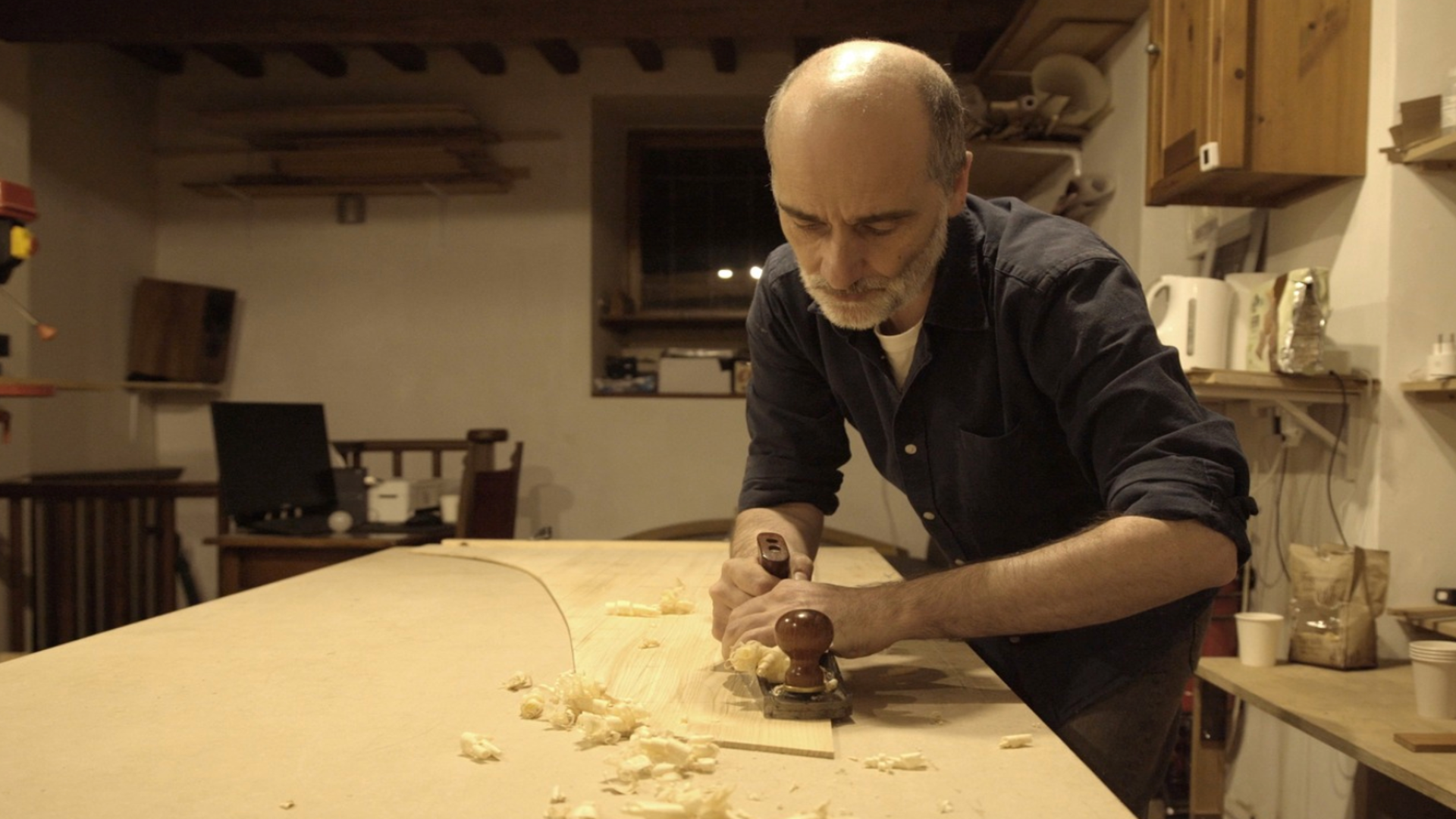 The copy’s soundboard is taking shape in Livi’s workshop.
The soundboard produced a genuine surprise — and an example of craft and measurement checking one another in the same room. Through the existing hole in the back of the original, we ran a magnetic gauge and mapped the soundboard’s thickness point by point. Because the board had never been thinned, the values came back unusually large. Livi was not convinced that a board so thick would sound well. So as the copy’s soundboard took shape, we measured its acoustic response repeatedly, and the board was ultimately made to follow the thickness map measured from the original — the maker’s instinct and the physical evidence brought into agreement rather than left to argue. The smaller details were reproduced with the same discipline.
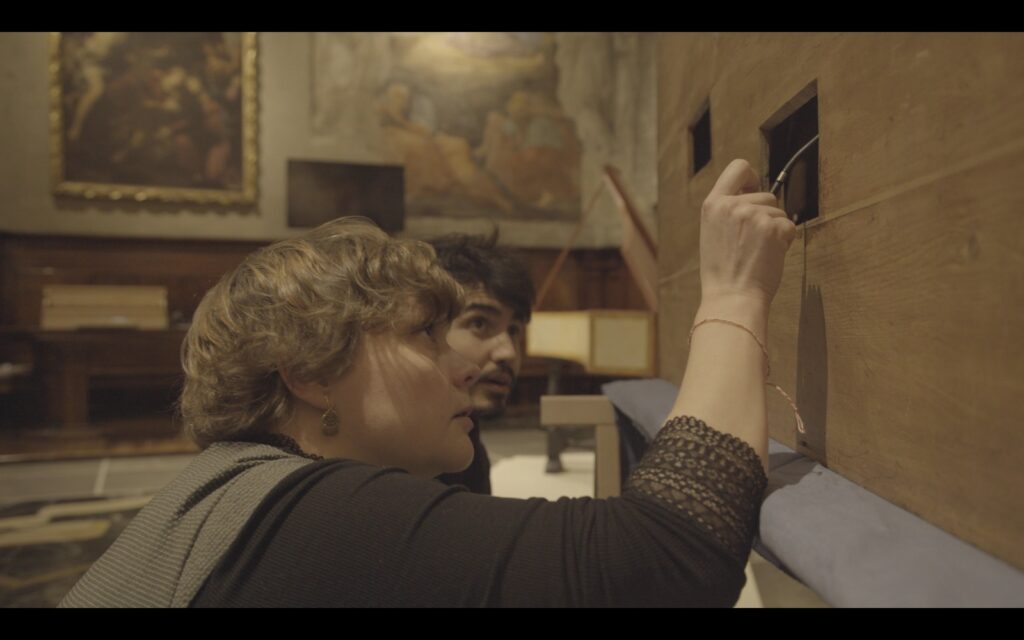 Accessing the interior of the original instrument through the hole on the back.
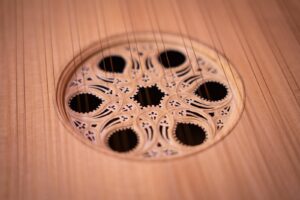
The plectra are cut and voiced individually from seagull quill. 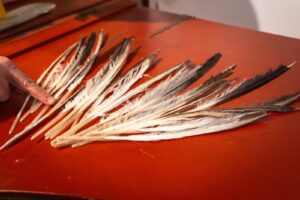 The decorative work was retraced in new wood as faithfully as the structure: the parchment rose cut layer by layer, the nameboard knotwork redrawn, the boxwood keys with their arcades.
  With the copy finished, we took it to Simone Coen’s studio near Milan for two recordings. The first is musical: Catalina Vicens — harpsichordist and curator of the Tagliavini Collection — recorded Italian Renaissance repertoire on the new instrument. The second is technical: a complete sample library of every note, at multiple articulations, captured as the raw voice that the museum keyboard would later play. The copy, in other words, did double duty — it made the music and the samples.
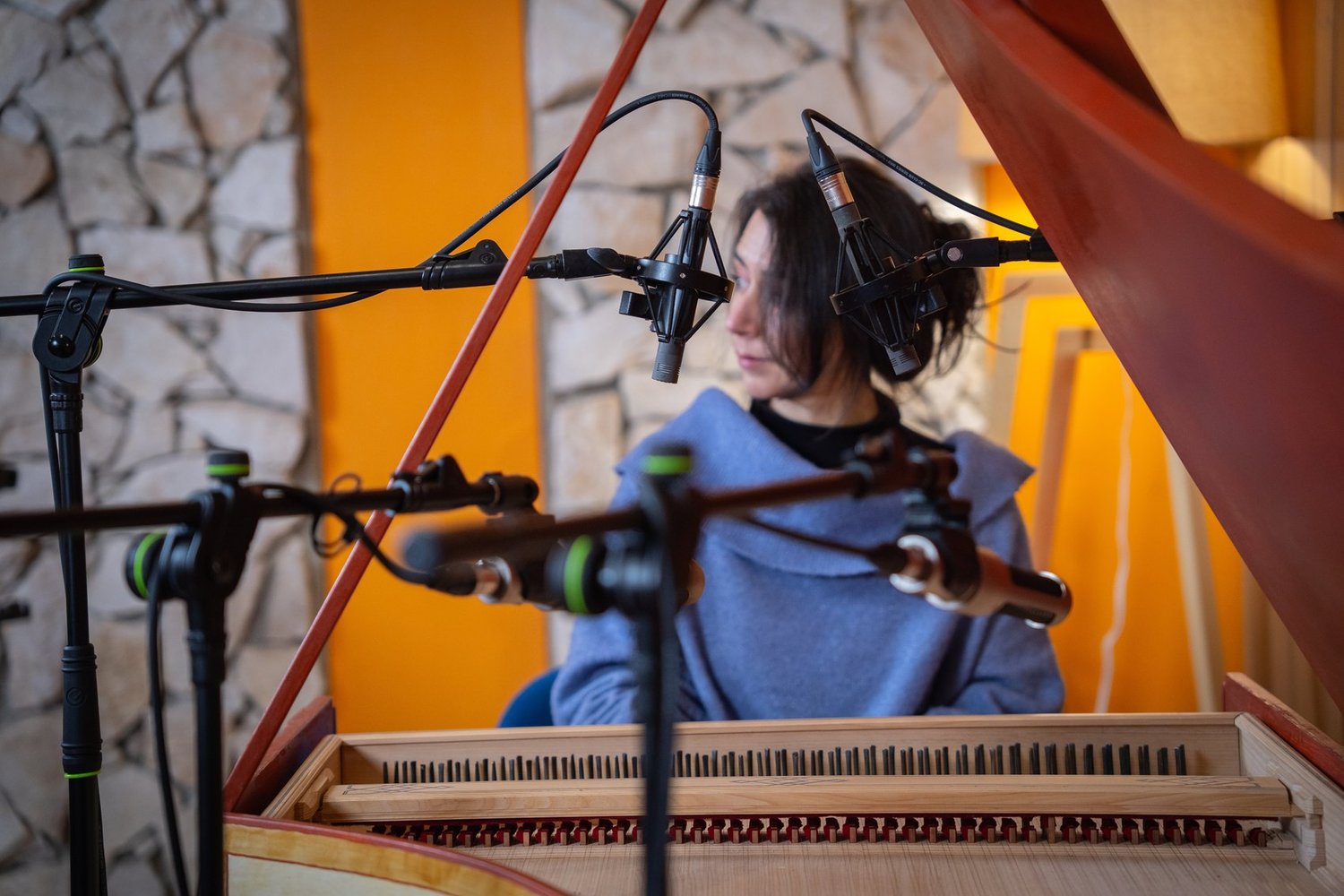 Catalina Vicens recording on the acoustic copy at Simone Coen’s studio in February 2026. Listen to an excerpt from a Gabrieli composition played by Catalina Vicens here.
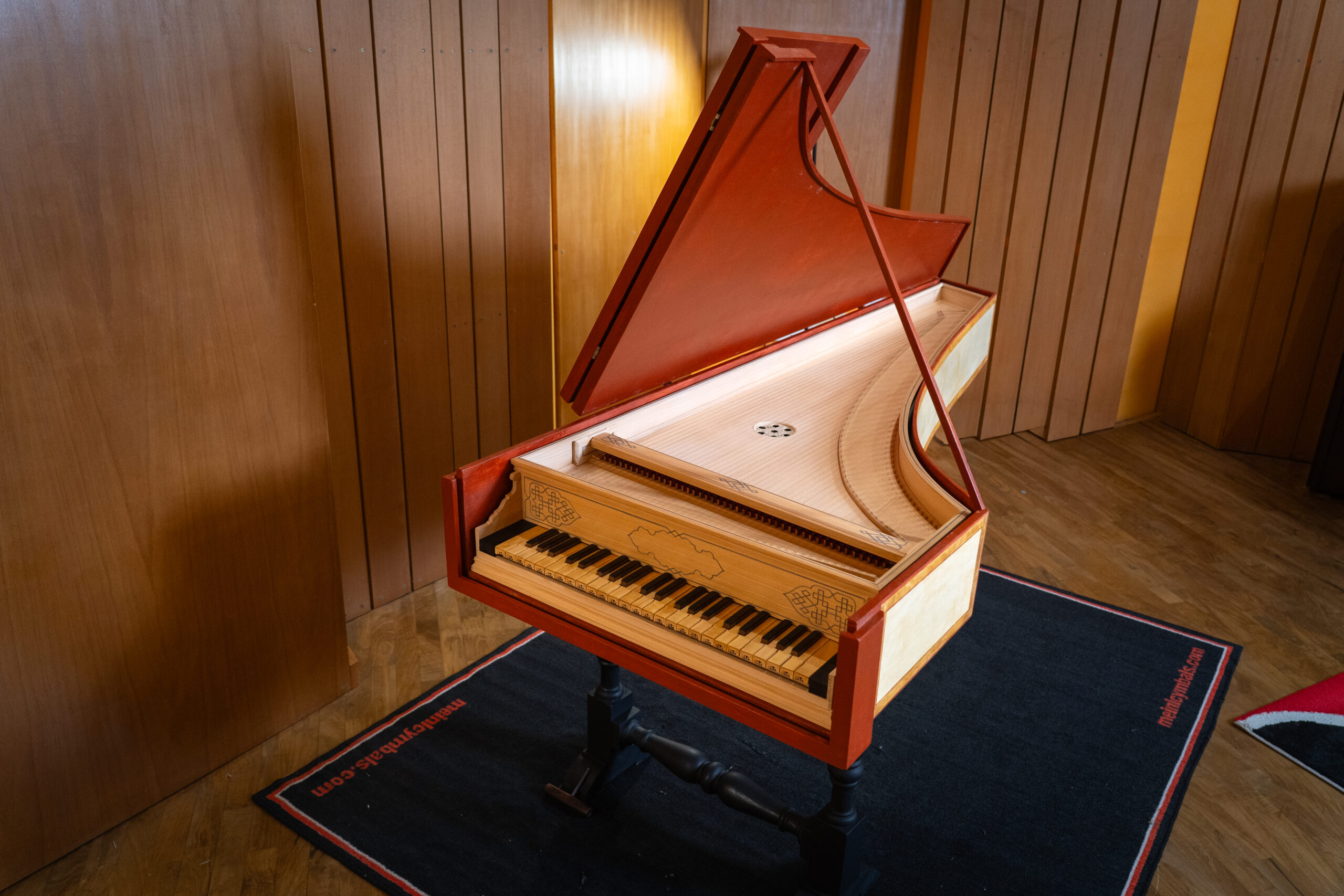 A view of the Livi harpsichord in Coen’ studio, February 2026.
Building the digital copy
The second keyboard is mechanically identical to the first and entirely traditional — the same keys, the same weight, the same timing. The whole problem of the digital copy was to make this keyboard speak without modernising a single part of it. How do you turn a wooden mechanism into a playable instrument while leaving the mechanism untouched?
The principle is to sense the action rather than replace it, and it builds on earlier work in the field. The design follows Andrew McPherson’s NIME-era revival of the Moog Piano Bar — originally a Don Buchla design, sold by Moog — a rail that sat over a piano keyboard and sensed the keys optically without altering them, the same lineage as the continuous optical key-sensing of McPherson’s magnetic resonator piano. The museum’s brief set the constraints: the solution had to be invisible, non-invasive, reliable, and easy for museum staff to maintain. The action stays untouched; the electronics only watch it.
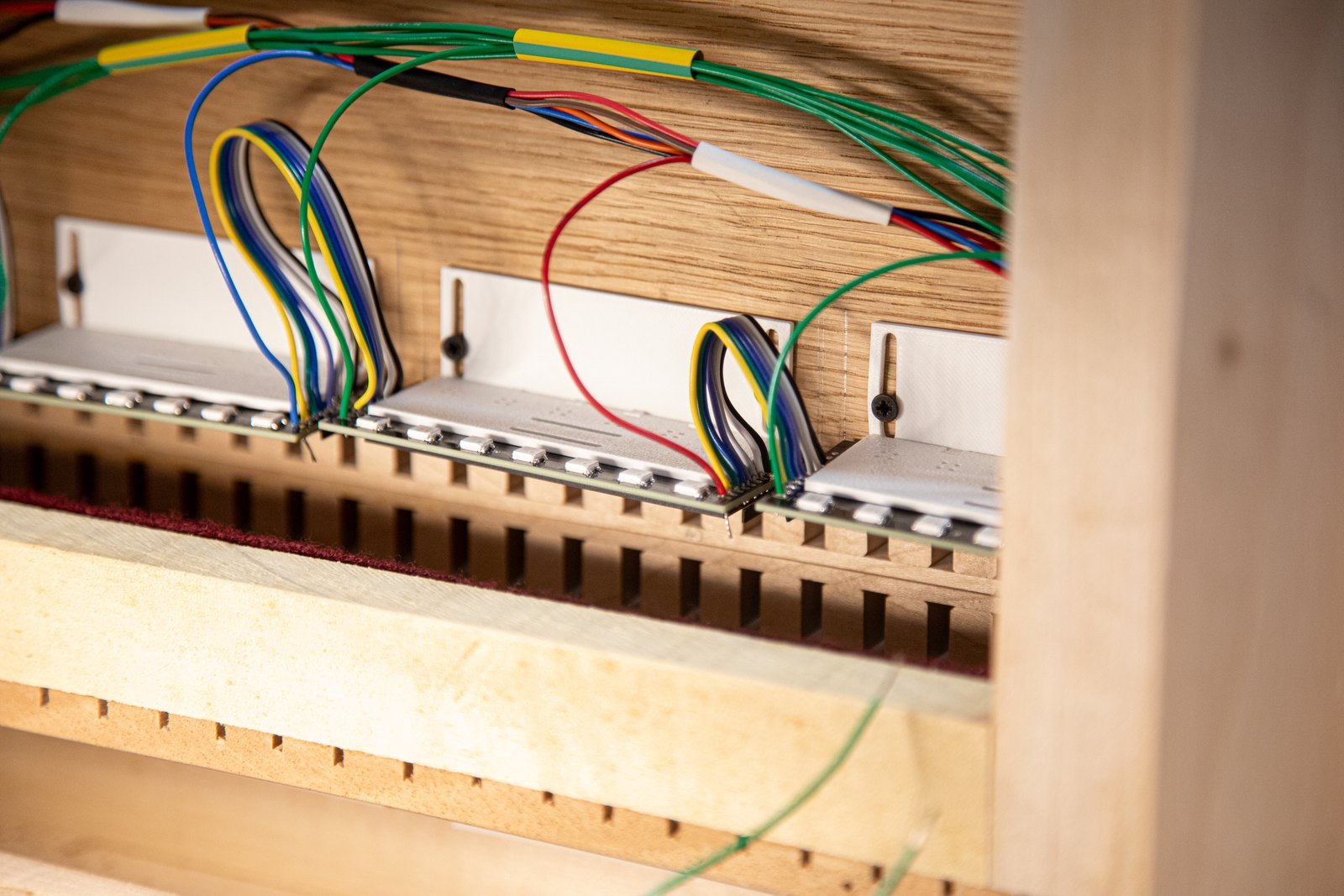 The optical sensing system installed beneath the jacks, with its wiring — nothing in the action is altered.
The mechanism is optical and deliberately simple. A single QRE1113 reflectance sensor reads each jack. On the side of each jack is a printed greyscale gradient, so that as the jack moves, its position is encoded as a continuously varying amount of reflected light. A small circuit applies hysteresis thresholds to that signal, converting it into the three things a synthesiser needs: note-on, note-off, and velocity. Nothing in the keyboard’s action is modified, drilled, or replaced; the sensors only measure how far each jack has travelled. The keys, their weight, and their timing remain the Trasuntino’s.
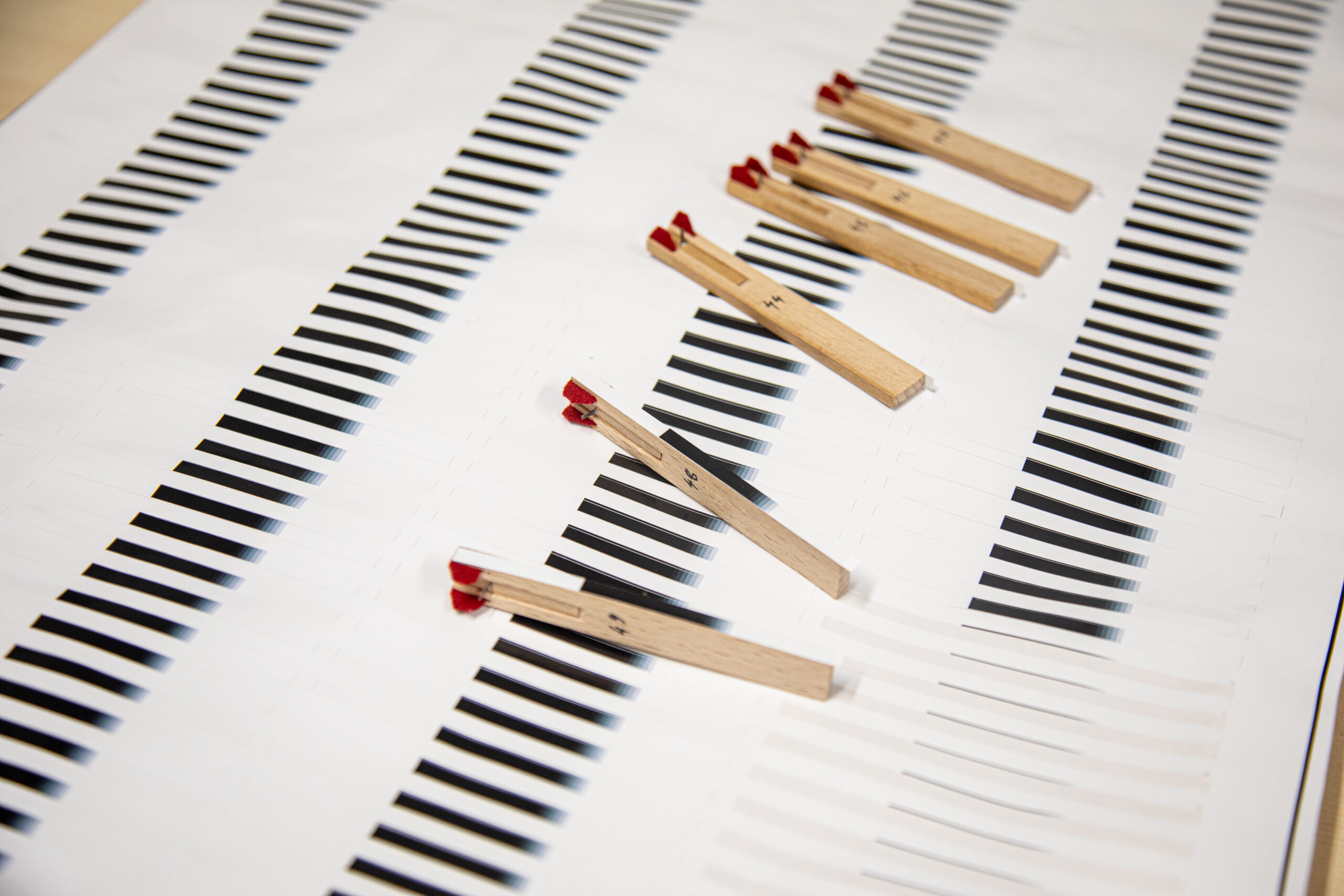 A printed greyscale gradient on each jack turns mechanical position into a light signal.
One property of this design matters for the future. Because the optical signal is continuous rather than a simple switch closure, the same hardware carries far more information than note-on/off and velocity require. That headroom leaves room for genuinely expressive control — aftertouch and beyond — for later models that go past straightforward sample playback.
The finished keyboard now sits in the permanent display at San Colombano, beside the paintings and the silent instruments. It is the one object in the room that visitors are invited to play. As a teaching instrument, it lets anyone discover what a harpsichord keyboard looks like, how its action feels, and what the instrument sounds like — and, as far as we know, no other collection holds a device quite like it. The public experiences the instrument, and the original keeps its silence.
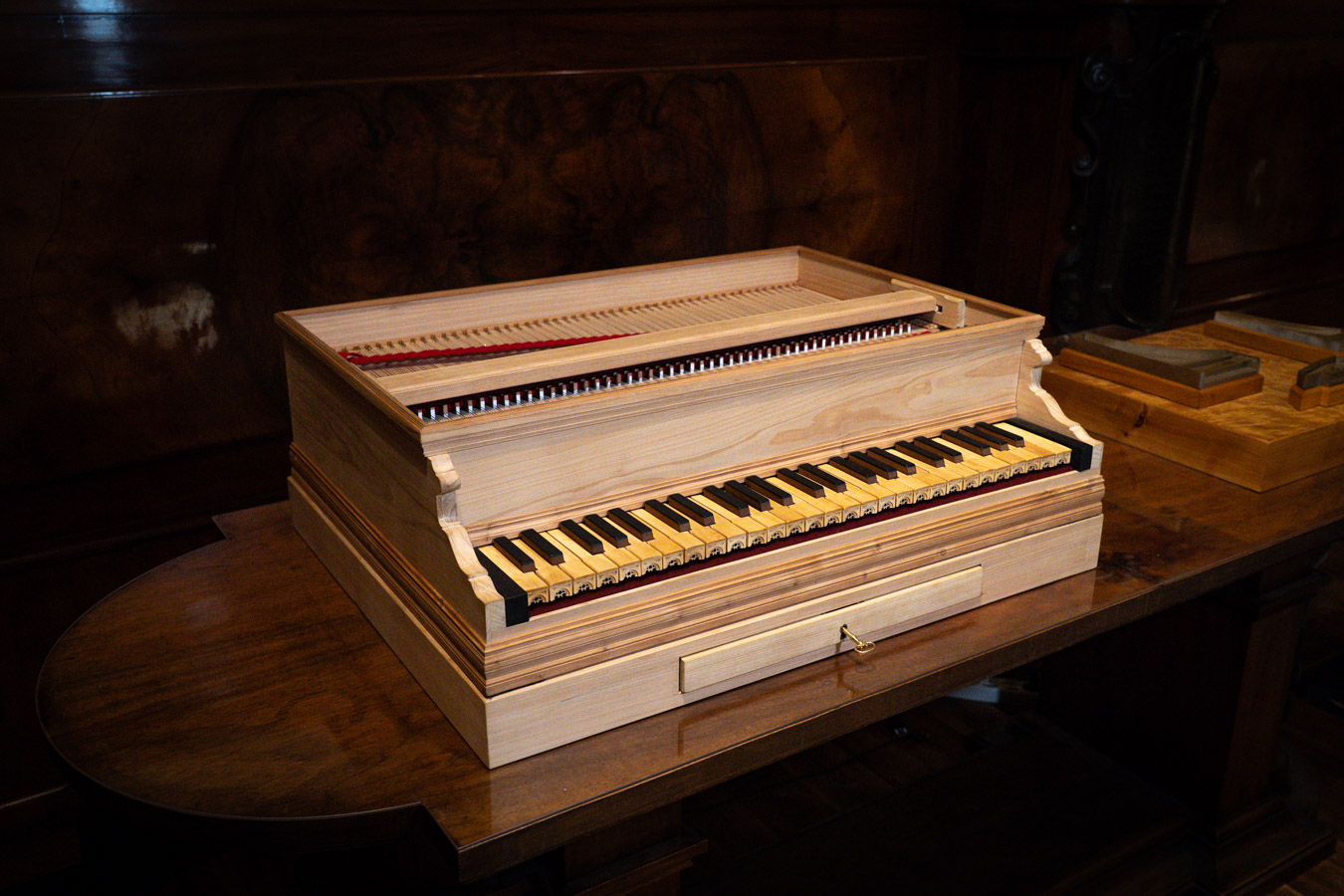 The control surface in the gallery: a 1547 keyboard action on the outside, samples within.
One idea, three bodies
The result of all this is three instruments — and the most useful way to think about them is not as one real instrument and two imitations.
The original is the document: damaged, silent, and full of evidence that exists nowhere else. The acoustic copy is the voice, returned to the world in new wood. The digital copy is the bridge: the form that lets anyone play the instrument without risking the original. They are three bodies of a single idea, each carrying it forward in a different way, each with a different job. This is, in the end, the resolution NEMUS offers to the old play-or-preserve dilemma — not a compromise between the two, but a way of having both at once.
The project also makes literal a conviction that runs from Major George Benton Fletcher’s keyboard collection at Fenton House in London — gathered expressly to be kept in original state and in playing condition, available to anyone studying the music — through to Tagliavini’s own bequest in Bologna, with its condition that a curator keep the instruments playing. The shared principle is that heritage should be available to everyone without endangering the unique originals that carry it. To honour it, the blueprints and the code are published openly, so that other makers and scholars can build on the work.
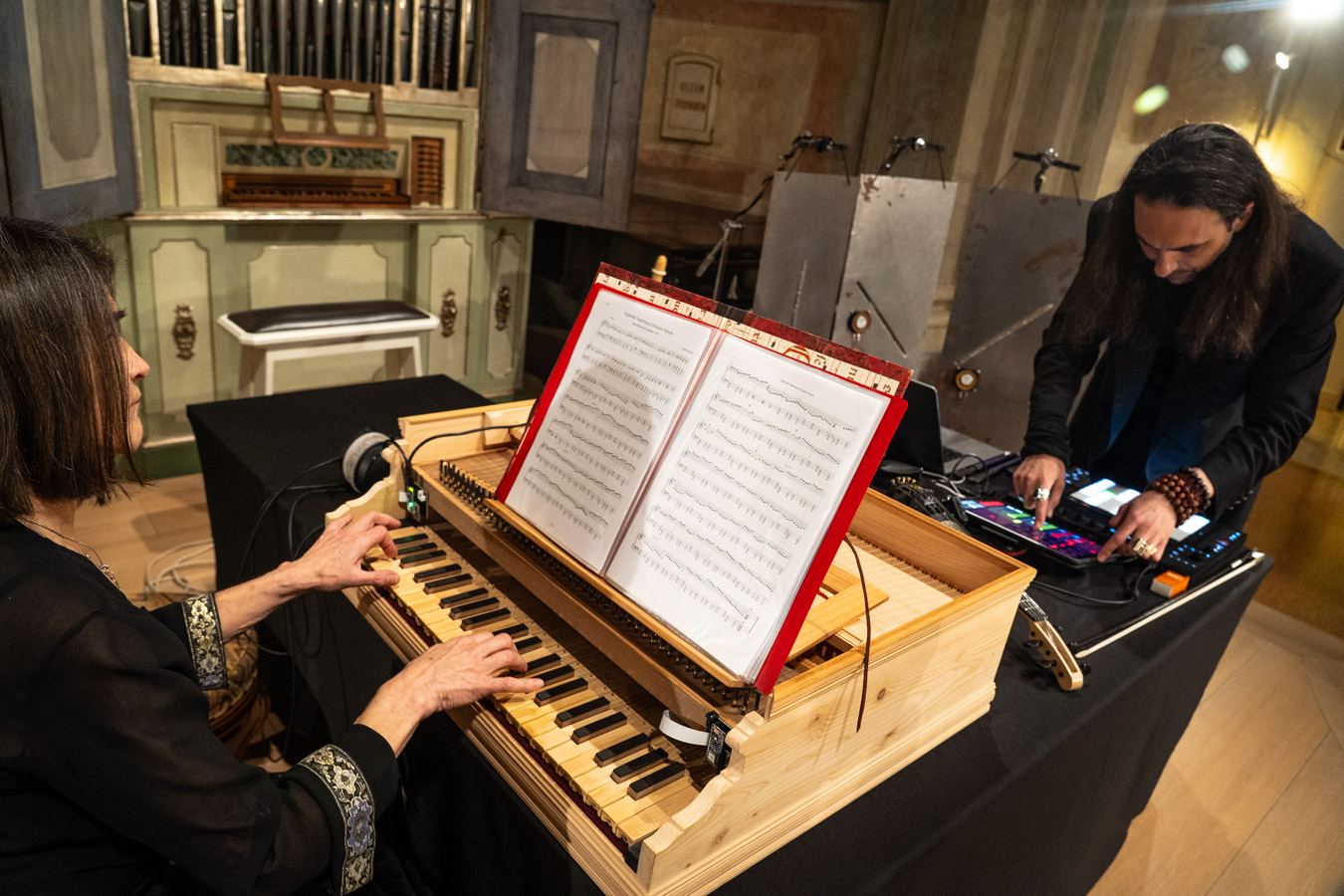
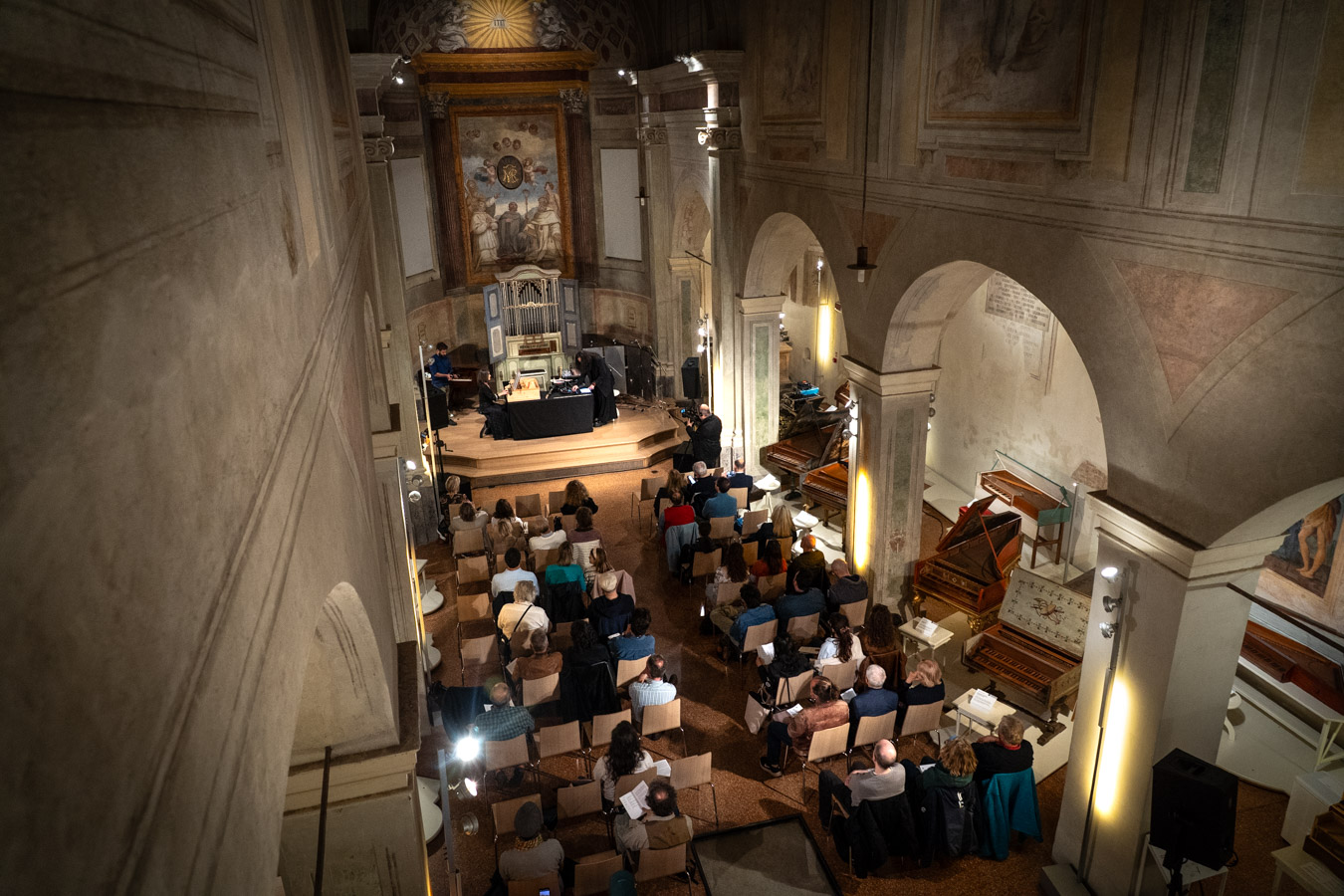
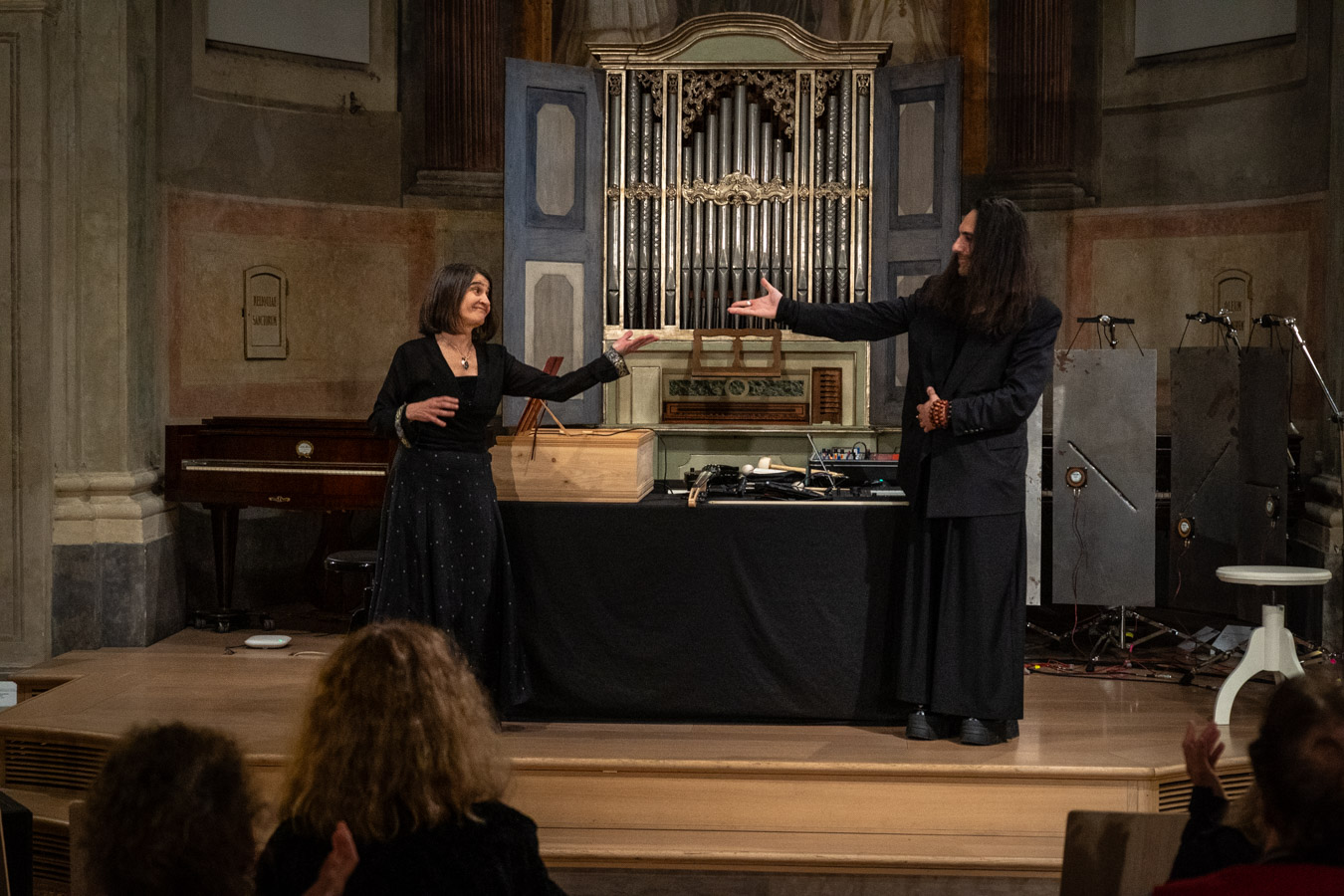 A 1547 action playing into 2026: from the concert Rinascimento Bionico, San Colombano.
The end of a journey?
NEMUS closed in 2026, but the instrument it produced is the start of something, not the end. The optical keyboard will host a second instrument: our in-house physical model of the harpsichord, running in place of the sample library, capable of behaviours the acoustic instrument cannot produce. Because the model’s control signal is continuous and polyphonic, it opens the door to expressive gestures the seventeenth century never had — a Renaissance instrument used as a contemporary one.
The work will also outlive the project. From the next academic year, composition students at the Bologna Conservatory will write for the keyboard. The case study was chosen to present the project’s central idea in its clearest form: that a copy need not be only a physical object, that part of an instrument can be made of numbers, and that doing so allows a museum to keep an instrument silent while sounding at the same time.
Audio examples and software
Listen to audio examples of the various instances of the Trasuntino project here. The sample libraries captured from Livi’s copy are available for free from the Software Download page.
Notes and references
The narrative of the ethics of restoration, and the Cristofori comparison, draw on the literature reviewed in the NEMUS research proposal; the organological description of the Trasuntino follows D. Wraight’s 2022 examination report prepared for the project, together with the archival work of Montanari (2009) and the sources cited on the provenance and states diagrams (Wraight 1997 and 2022; Montanari 2009; M. K. O’Brien 1994; Michel 1963 and 1970; the Dizionario Biografico degli Italiani, s.v. “Trasuntino”; and the Golden Crest CR-4031 sleeve). Page-level citations to the examination report are available on request.
[1] A. Lamb. To play or not to play: the ethics of musical instrument conservation. Conservation Journal, 15:12–15, 1995.
[2] International Committee for Museums and Collections of Musical Instruments (ICOM). Copies of historical musical instruments. CIMCIM Publications no. 3, 1994.
[3] M. Oey. Some problems in conservation in museum collections. In Proceedings of the Association of North American Graduate Programs in Conservation, Winterthur, USA, 2006.
[4] S. Pollens. The Manual of Musical Instrument Conservation. Cambridge University Press, Cambridge, UK, 2015.
[5] D. Wraight. Recent approaches in understanding Cristofori’s fortepiano. Early Music, 34:635–644, 2006.
[6] G. O’Brien. The 1690 spinetta ovale by Bartolomeo Cristofori. In Proceedings of the Restoration and Conservation of Early Musical Instruments, Florence, Italy, 2008.
[7] International Council on Monuments and Sites. International charter for the conservation and restoration of monuments and sites (the Venice Charter). Venice, Italy, 1964.
[8] American Institute for Conservation. Code of ethics and guidelines for practice. New York, USA, 1963.
[9] J. Barnes. Does restoration destroy evidence? Early Music, 8(2):213–218, 1980.
[10] G. O’Brien. The conservation of historical keyboard instruments: to play or to preserve? In Per una carta europea del restauro: conservazione, restauro e riuso degli strumenti musicali antichi, Florence, Italy, 1987.
[11] International Committee for Museums and Collections of Musical Instruments (ICOM). Recommendations for the conservation of musical instruments: an annotated bibliography. CIMCIM Publications no. 1, 1993.
[12] American Institute for Conservation. Code of ethics and guidelines for practice. Washington, USA, 1994.
[13] Museums and Galleries Commission. Standards in the museum care of musical instruments. London, UK, 1995.
[14] International Committee for Museums and Collections of Musical Instruments (ICOM). Musical Instruments: Do They Have to Sound? St Petersburg, Russia, September 2002 (conference proceedings).
[15] S. Pollens. Flemish harpsichords and virginals in the Metropolitan Museum of Art. Metropolitan Museum Journal, 32:85–110, 1997.
[16] J. R. Watson. Historical musical instruments: a claim to use, an obligation to preserve. Journal of the American Musical Instrument Society, 17:62–82, 1991.
[17] C. Karp. Restoration, conservation, repair and maintenance. Early Music, 7:79–84, 1979.
[18] C. Karp. Musical instruments in museums. International Journal of Museum Management and Curatorship, 4(2):179–182, 1985.
[19] J. Barnes. Making a Spinet by Traditional Methods. Peacock Press, Mytholmroyd, UK, 1985.
[27] H. McGurk and J. MacDonald. Hearing lips and seeing voices. Nature, 264(5588):746–748, 1976.
[28] D. Wraight. Examination report on the 1547 Trasuntino harpsichord. Prepared for the NEMUS project, 2022. Sections I–X.
The authors thank the Tagliavini Collection — Genus Bononiae and Fondazione Carisbo for access to the instrument; master harpsichord builder Roberto Livi; Catalina Vicens; Simone Coen; and the photographers Arianna Favalli and Andrea Grasselli. Special thanks to Maria Luisa Baldassari and Gadi Sassoon for performing Rinascimento Bionico using the augmented keyboard.